Abstract
This article investigates the effect of tantalum oxide (Ta2O5) modification on the hardness properties of aluminum-silicon (Al-Si) alloys through mathematical modeling and parametric evaluation. During the experimental studies, the influence of varying amounts of tantalum oxide particles on the mechanical properties-particularly hardness-was examined, and the relationship between them was clarified based on experimental results. The findings indicate that the addition of tantalum oxide has a significant impact on the hardness of the alloy. The modifier was introduced into the samples in specially wrapped form, and the samples were cast into sand–clay molds. Within a certain optimal concentration range, the hardness reaches its maximum value, which can be explained by microstructural refinement and improved phase distribution. However, when the amount of additive exceeds this optimal level, a slight decrease in hardness is observed due to particle agglomeration and segregation in the samples. Based on the research results, a mathematical model describing the relationship between tantalum oxide content and hardness was developed. This model shows good agreement with experimental data and can be effectively used as a tool for selecting the optimal composition of Al–Si alloys and predicting their mechanical properties.
Highlights
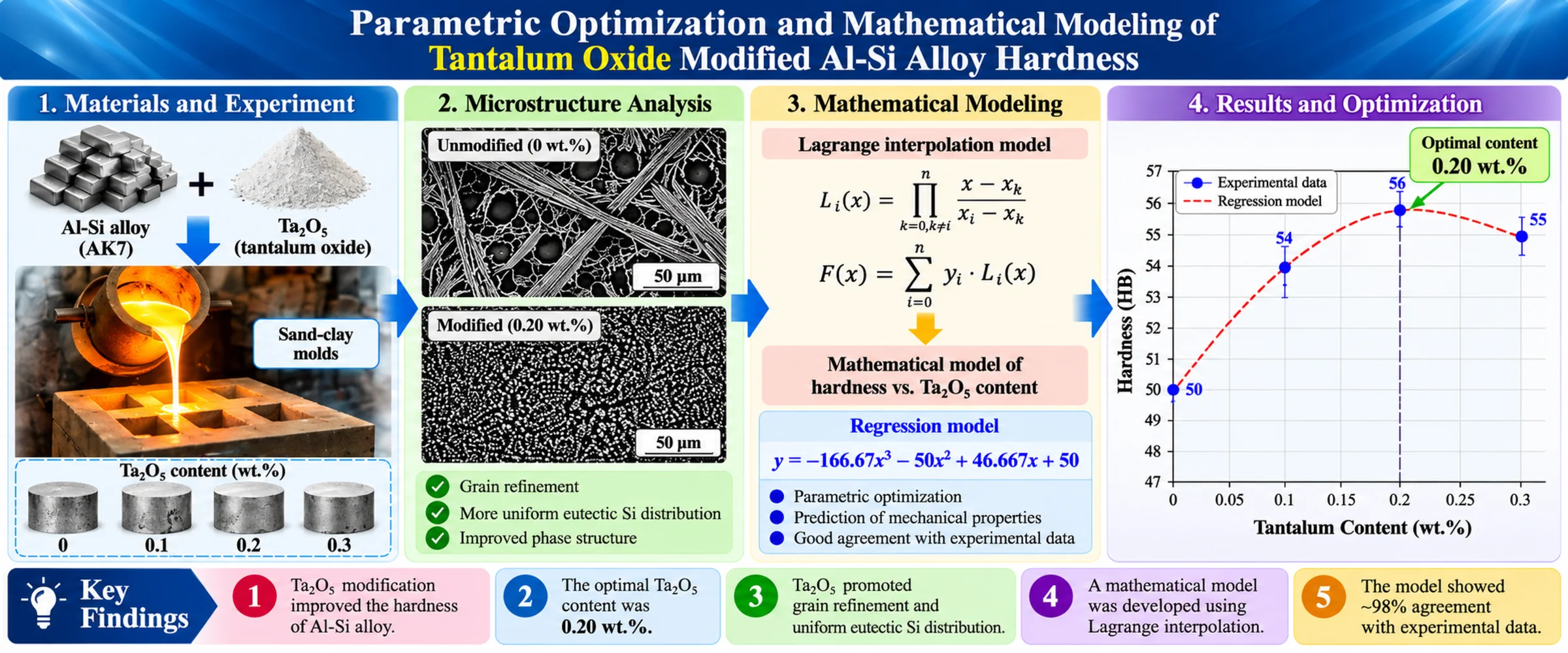
- Ta₂O₅ modification improved the hardness of Al-Si alloy.
- The optimal Ta₂O₅ content was determined as 0.20 wt.%.
- Ta₂O₅ promoted grain refinement and uniform eutectic Si distribution.
- A mathematical model was developed using Lagrange interpolation.
- The model showed approximately 98% agreement with experimental data.
1. Introduction
In the production of aluminum and its alloys by casting methods, the mechanical properties of the alloy play a decisive role in determining the performance and service life of the final product [1-3]. Among these properties, hardness is one of the most important, as it directly affects the strength, wear resistance, and resistance to deformation of the alloy [4-7].
At present, numerous studies conducted by researchers worldwide are focused on improving the mechanical properties of aluminum–silicon alloys through microalloying and modification with various modifiers. In addition, efforts are being made to optimize alloy modification processes using mathematical modeling based on experimental results [8-12].
In particular, Franc Zupanič and co-authors investigated the effect of the friction stir processing (FSP) process on the microstructure in the stir zone of a micro alloyed Al-Mn-Cu alloy. According to their findings, due to high temperature and severe plastic deformation, the grains undergo significant refinement, decreasing in size from about 120 μm to several micrometers. At the same time, the initial coarse intermetallic phases are fragmented into fine dispersed particles and predominantly transform into the stable τ1-Al29Mn6Cu4 phase. In the heat-treated condition, the quasi-crystalline (IQC) precipitates dissolve completely during the friction stir processing (FSP) process, whereas the L12-Al3(Sc, Zr) precipitates are partially retained and undergo coarsening. As a result, the amount of dispersed strengthening phases decreases, leading to an approximately 25 % reduction in hardness, particularly in the heat-treated samples, while in the as-cast condition the hardness remains nearly unchanged. Overall, the FSP process significantly alters the microstructure and phase composition; however, due to the dissolution of precipitates, it does not always result in an improvement of mechanical properties [13].
In the study titled “Evaluation of the Effect of Alloying Elements on the Mechanical and Electrical Properties of Aluminum” [14], conducted by T. Knych and co-authors, the influence of Si, Mn, Mg, Cu, and Zn on the mechanical and electrical properties of aluminum was investigated. The results showed that the addition of these alloying elements leads to an increase in the strength and hardness of aluminum, while the relationship between composition and electrical conductivity remains largely unchanged. It was also observed that an increase in manganese content contributes to the deterioration of electrical properties. Furthermore, during the transition from a solid solution to highly segregated phases, no significant increase in the concentration level within the aluminum matrix was detected. The study also demonstrated that the strengthening effect of alloying additions follows a trend close to linear behavior. In a study by Pammer et al. (2023), it was demonstrated that the addition of small amounts of tantalum to Al-Si alloys significantly improves the microstructure. In particular, tantalum acts as a grain refiner and reduces the “silicon poisoning” effect caused by silicon. As a result, the -Al grains become refined, leading to improved mechanical properties, including hardness. This study highlights the direct relationship between the modification process and hardness [15]. The above-mentioned studies are primarily based on experimental results; however, there has been no research focused on mathematically modeling the effect of tantalum oxide modification on the hardness of aluminum–silicon alloys. In this article, the effect of tantalum oxide on the hardness of Al-Si alloys is investigated through mathematical modeling based on experimental data obtained from practical studies.
2. Materials and methods
In hardness testing of aluminum–silicon alloys, the surface layer of the specimen is examined; therefore, careful surface preparation is essential. The tested surface must be free from defects, properly ground, and smoothly polished to ensure reliable results. The hardness of alloys has a significant influence on their overall properties. For this reason, hardness measurements are widely used as an indirect method for evaluating the strength characteristics of materials, particularly in cases where tensile testing is impractical.
Among the commonly applied hardness testing methods for aluminum alloys are the Brinell and Rockwell tests, each selected based on the alloy composition, hardness range, and specimen geometry [16]. The chemical composition of the aluminum-silicon alloy selected as the research object is presented in Table 1. The alloy primarily consists of up to 93.6 % aluminum and up to 8 % silicon. Silicon reduces the ductility and strength of the alloy, as it forms brittle inclusions and intermetallic compounds within its structure [17]. Due to its excellent casting properties, aluminum-silicon alloys are widely used in the production of complex components and mechanical parts employed in engineering applications [18].
Table 1Chemical composition of aluminum-silicon alloys
Fe | Si | Mn | Ni | Al | Cu | Mg | Zn |
till 1.3 | 6-8 | 0.2-0.6 | till 0.3 | 87.6-93.6 | till 1.5 | 0.2-0.5 | till 0.5 |
3. Results and analysis
In this study, the variation in sample hardness was evaluated using the Brinell hardness scale. The aluminum-silicon alloy was completely melted in a casting furnace at a temperature of 740-760 °C, and the surface of the melt was protected with a flux. Subsequently, fine-dispersed tantalum (V) oxide (Ta2O5) particles with a size of 1-3 μm were mixed with aluminum powder, compacted into briquettes, and introduced directly into the molten metal in the ladle during the casting process. After the addition of Ta2O5, the melt was stirred in the ladle for 2-3 minutes to ensure the uniform distribution of the oxide particles throughout the molten alloy. The hardness of each sample was then measured using a THBRV-187.5DX universal hardness tester. Measurements were taken at three different locations on the surface of each specimen, and the average value was calculated. The final hardness of each sample was determined according to the Brinell hardness scale (HB). Based on the experimental results, a graph illustrating the relationship between the Ta2O5 particle content and the hardness of the aluminum alloy was constructed (Fig. 1). The addition of Ta2O5 increased the number of heterogeneous nucleation sites in the molten alloy, resulting in grain refinement of the -Al phase and a finer, more uniform distribution of the eutectic Si phase. Furthermore, the high-hardness Ta2O5 ceramic particles acted as a dispersion-strengthening phase, effectively restricting plastic deformation. Consequently, the hardness of the cast aluminum alloy was significantly improved.
Fig. 1Dependence of the Brinell hardness of the aluminum alloy on Ta2O5 particle content
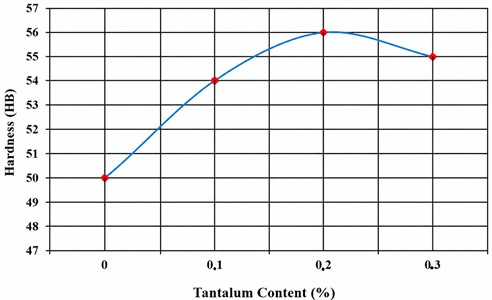
When the Ta2O5 content was increased to 0.10-0.20 %, the hardness of the alloy rose from 50 HB to 56 HB. This improvement is attributed to dispersion strengthening and the restriction of dislocation movement. However, when the Ta2O5 content was further increased to 0.30 %, a slight decrease in hardness was observed, which is associated with particle agglomeration and a reduction in strengthening efficiency.
In the next stage, the effect of tantalum oxide introduced into aluminum–silicon alloys were mathematically modeled [19]. Initially, a mathematical model describing the dependence of alloy hardness on the percentage content of Ta2O5 was developed. For this purpose, experimental results obtained from practical studies (Fig. 2) were used.
Based on the experimental data, four data points – (0, 50), (0.1, 54), (0.2, 56), and (0.3, 55) – were taken as input values. Using these points, the initial form of a cubic polynomial function was constructed as follows: , where – Lagrange basis polynomials, – the -coordinates of the points.
At the initial stage of the calculation, the terms are determined; each is defined by the following formula:
In the considered case, based on the experimental data at the points 0, 0.1, 0.2, and 0.3, the following expressions are obtained:
a) (0, 50):
b) (0.1, 54):
c) (0.2, 56):
d) (0.3, 55):
Fig. 2Scheme for developing the mathematical model based on experimental results and their graphs
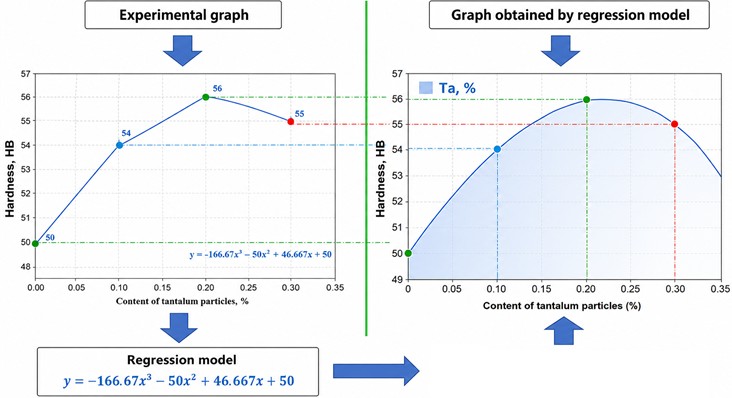
The following data points were obtained from experimental studies: 50; 54; 56; 55.
Thus, using the above results, we can express as follows:
From this, the following formula is obtained:
Then, we simplify the obtained expression step by step as follows:
(): ;
(): ;
(): ;
(): .
Now, we add all the expressions and combine all the terms. Then, using the obtained results, we derive the following mathematical model describing the dependence of the hardness of aluminum-silicon alloys modified with tantalum oxide on the percentage of tantalum oxide. This model is valid within the range of the minimum and maximum values of the modifier added during the experiments [20]:
Using the PTC Mathcad software, we construct the graph of the developed mathematical model based on the Lagrange interpolation method. To verify the reliability of the obtained regression equation, the values of the experimentally obtained data points are entered into the program and tested. By comparing the graph obtained during the experiments with the graph generated using the developed mathematical model, it was determined that the model shows a 98 % agreement (Fig. 3).
4. Conclusions
Based on the experimental results, the optimal addition of Ta2O5 to the aluminum-silicon alloy during ladle treatment was determined to be approximately 0.20 wt.%. At this concentration, tantalum oxide produced the greatest improvement in alloy hardness, indicating its effectiveness as a modifying agent. The proposed modification technique is readily applicable to conventional casting processes, requires no additional sophisticated equipment, and therefore offers strong potential for industrial implementation. In addition, the relationship between the hardness of Ta2O5 modified aluminum-silicon alloys and the modifier content were mathematically described using the Lagrange interpolation method. The developed model is valid within the range of the experimental data and was verified through graphical analysis in PTC Mathcad. Comparison of the predicted and experimental hardness values demonstrated an agreement of approximately 98 %, confirming the high accuracy and reliability of the model for predicting alloy hardness within the investigated composition range.
References
-
H. R. Ammar, A. M. Samuel, and F. H. Samuel, “Effect of casting imperfections on the fatigue life of 319-F and A356-T6 Al-Si casting alloys,” Materials Science and Engineering: A, Vol. 473, No. 1-2, pp. 65–75, 2007, https://doi.org/10.1016/j.msea.2007.03.112
-
B. Harjanto and H. Hirman, “Effect of pouring temperature and aluminum fluidity (Al-9%Si) on mechanical and physical properties in evaporative casting using the Birmingham model,” (in Indonesian), NOZEL Jurnal Pendidikan Teknik Mesin, Vol. 7, No. 1, p. 41, 2025, https://doi.org/10.20961/nozel.v7i1.97833
-
S. Tursunbaev, N. Turakhodjaev, L. Zhang, Z. Wang, U. Mardonov, and M. Saidova, “Mechanical properties and evolution of the microstructure of Al-Cu-Mg system alloys under the influence of alloying elements (GE AND SI),” International Journal of Mechatronics and Applied Mechanics, Vol. I, No. 18, pp. 164–169, Dec. 2024, https://doi.org/10.17683/ijomam/issue18.19
-
X. Ren et al., “Influence of Y2O3/CeO2 on the microstructure and properties of AlCrFeNiCu high-entropy alloy coating,” International Journal of Minerals, Metallurgy and Materials, Vol. 33, No. 4, pp. 1297–1309, 2026, https://doi.org/10.1007/s12613-026-3413-x
-
Z. An et al., “On the strengthening effect of Al-Cr-Si dispersoid in an Al-Si-Mg-Cu casting alloy with Cr addition,” Materials Characterization, Vol. 166, p. 110457, Jun. 2020, https://doi.org/10.1016/j.matchar.2020.110457
-
S. Tursunbaev, N. Turakhodjaev, S. Mardonakulov, and S. Toshmatova, “Effect of germanium oxide on the properties of aluminum casting details in agricultural machinery,” BIO Web of Conferences, Vol. 85, p. 01024, Jan. 2024, https://doi.org/10.1051/bioconf/20248501024
-
S. Tursunbayev, N. Turakhodjayev, S. Mardanokulov, R. Zokirov, and F. Odilov, “The effect of lithium on the mechanical properties of alloys in the Al-Li system,” E3S Web of Conferences, Vol. 390, p. 05046, Jun. 2023, https://doi.org/10.1051/e3sconf/202339005046
-
A. Zykova, L. Kazantseva, N. Popova, A. Vorozhtsov, and I. Kurzina, “Influence of modifying mixtures on Si crystal formation in Al-7%Si alloy,” Metals, Vol. 8, No. 2, p. 98, Jan. 2018, https://doi.org/10.3390/met8020098
-
N. Turakhodjaev, M. Akramov, S. Turakhujaeva, S. Tursunbaev, A. Turakhujaeva, and J. Kamalov, “Calculation of the heat exchange process for geometric parameters,” International Journal of Mechatronics and Applied Mechanics, Vol. I, No. 9, pp. 90–95, Jul. 2021, https://doi.org/10.17683/ijomam/issue9.13
-
Z.-W. Chen, C.-Y. Ma, and P. Chen, “Modifying agent selection for Al-7Si alloy by Miedema model,” International Journal of Minerals, Metallurgy and Materials, Vol. 19, No. 2, pp. 131–135, 2012, https://doi.org/10.1007/s12613-012-0527-0
-
X. Cui et al., “Study on mechanism of refining and modifying in Al-Si-Mg casting alloys with adding rare earth cerium,” Materials Research Express, Vol. 10, No. 8, p. 086511, 2023, https://doi.org/10.1088/2053-1591/acece0
-
O. Y. Tkacheva, I. G. Brodova, P. A. Arhipov, and Y. P. Zaikov, “Influence of crystallization conditions on the structure and modifying ability of Al-Sc alloys,” Russian Journal of Non-ferrous Metals, Vol. 58, No. 1, pp. 67–74, Mar. 2017, https://doi.org/10.3103/s1067821217010126
-
F. Zupanič et al., “Microstructural evolution in the stir zone of a friction-stir-processed microalloyed Al-Mn-Cu alloy,” Metals, Vol. 16, No. 3, p. 358, 2026, https://doi.org/10.3390/met16030358
-
T. Knych, A. Mamala, and W. Ściężor, “Effect of selected alloying elements on aluminium physical properties and its effect on homogenization after casting,” Materials Science Forum, Vol. 765, pp. 471–475, Jul. 2013, https://doi.org/10.4028/www.scientific.net/msf.765.471
-
M. Pammer, J. Pölzl, and J. Li, “Silicon poisoning and effects of tantalum on AlSi alloys,” Metals, Vol. 13, No. 12, p. 1917, Nov. 2023, https://doi.org/10.3390/met13121917
-
D. V. Vinnikov, “Effect of phase composition on the wear and corrosion resistances of the aluminium oxide coatings formed on the Al alloy substrate by microplasma oxidation,” Functional Materials, Vol. 29, No. 2, Jun. 2022, https://doi.org/10.15407/fm29.02.221
-
M. Mahmudzoda, B. B. Eshov, and J. H. Dzhailoev, “Anodic behavior of AK7 aluminum alloy and composite material of the Al-Al2O3 system within an NaCl electrolyte solution medium,” Metallurgist, Vol. 67, No. 9-10, pp. 1466–1472, Mar. 2024, https://doi.org/10.1007/s11015-024-01639-z
-
A. Turakhujaeva et al., “Mathematical modeling of the effect of the lithium element on the fluidity of Al-Si and Al-Cu alloys,” in Lecture Notes in Networks and Systems, Vol. 1592, Cham: Springer Nature Switzerland, 2025, pp. 62–69, https://doi.org/10.1007/978-3-032-02508-1_6
-
T. Nodir, T. Sarvar, J. Andrey, and M. Yahyojon, “Mathematical model for calculating heat exchange,” in Lecture Notes in Networks and Systems, Vol. 305, Cham: Springer International Publishing, 2021, pp. 243–249, https://doi.org/10.1007/978-3-030-83368-8_24
-
S. Tursunbaev et al., “Comparison of the effect of germanium (Ge) and germanium-silicon (Ge-Si) combinations on the hardness of aluminum alloy through mathematical modeling,” in Optical and Computational Technologies for Measurements and Industrial Applications (OptiComp 2025), Vol. 13803, p. 34, 2025, https://doi.org/10.1117/12.3077575
About this article

The authors have not disclosed any funding.
The datasets generated during and/or analyzed during the current study are available from the corresponding author on reasonable request.
The authors declare that they have no conflict of interest.

