Abstract
This study investigates the dynamic behavior of high-rise engineering structures equipped with cylindrical liquid reservoirs under seismic and harmonic excitations. The research focuses on the development of a mathematical model describing the coupled vibration of an elastic vertical structure and a contained incompressible fluid. The governing differential equations of transverse vibrations are formulated considering complex boundary conditions and the interaction between the structure, the fluid, and the supporting soil. Analytical solutions for the natural frequencies and vibration modes of the system are obtained using integral transform techniques and Krylov functions. The influence of structural parameters, fluid mass, and boundary conditions on the vibration characteristics is analyzed. Numerical calculations are performed using computational tools to determine the roots of the frequency equation and evaluate dynamic displacement functions. The results demonstrate that the presence of fluid significantly affects the dynamic response of the structure and may alter its vibration frequencies depending on the filling level of the reservoir. The proposed model can be applied in seismic engineering and vibration analysis of industrial structures such as towers, tanks, and hydro-engineering facilities. The obtained theoretical results provide a basis for improving structural safety and reliability under dynamic loads.
Highlights
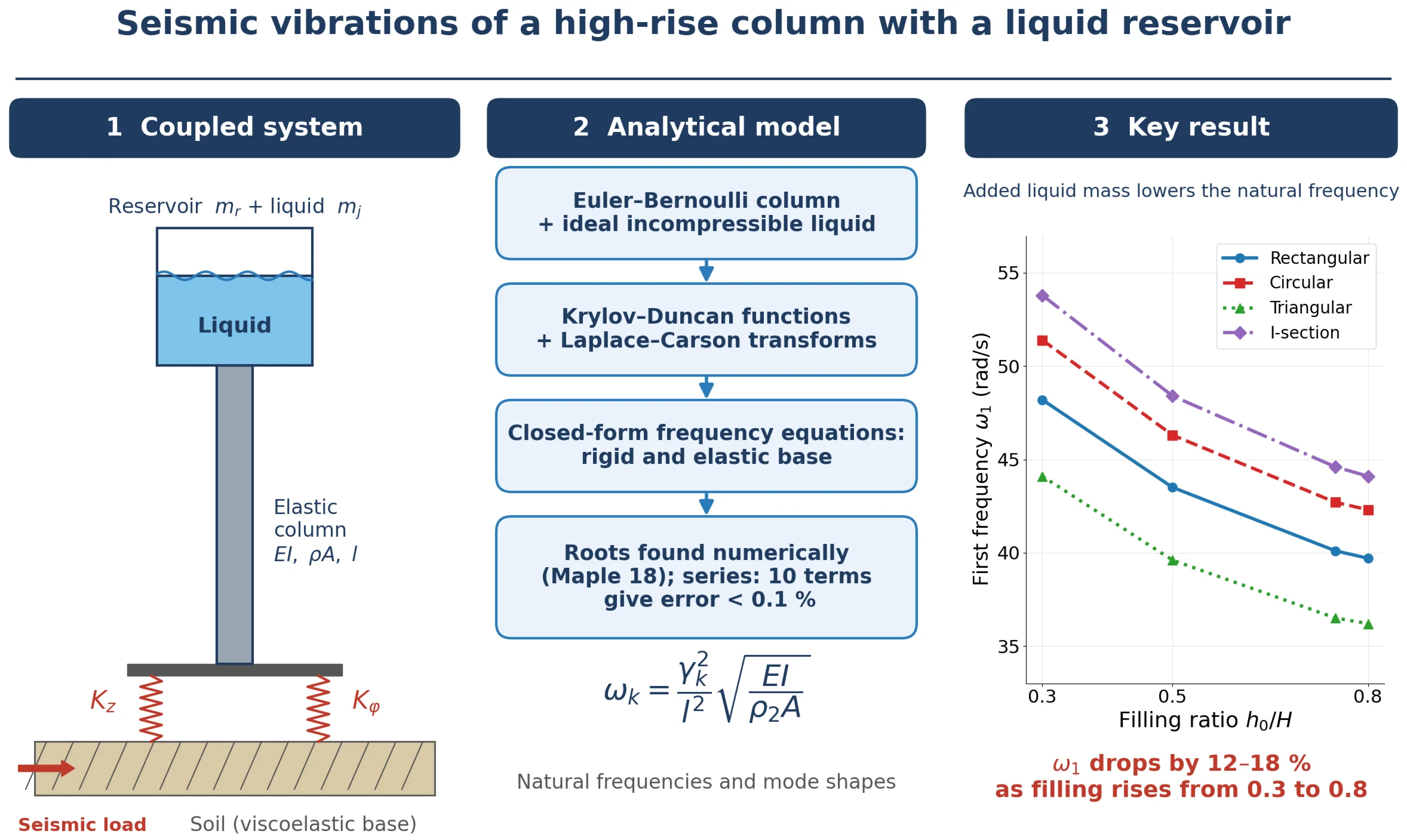
- A unified analytical model is developed for coupled transverse vibrations of an elastic column with a top-mounted cylindrical liquid reservoir and soil–structure interaction.
- Krylov–Duncan functions and Laplace–Carson transforms yield closed-form frequency equations for a rigidly fixed base and for elastic (translational and rotational) base conditions.
- Raising the reservoir filling ratio from 0.3 to 0.8 lowers the first natural frequency by about 12–18 %, while the fundamental mode shape remains qualitatively unchanged.
- The series in the frequency equations converge rapidly: 5 terms give an error below 1 % and 10 terms below 0.1 % for the first root, so the model is efficient for design use.
- The inviscid-fluid assumption holds for water (damping ratio < 0.5 %), but viscous damping becomes significant for highly viscous liquids such as glycerol at low frequencies.
1. Introduction
Ensuring the dynamic stability and seismic safety of engineering structures is a paramount challenge in modern structural and vibration engineering. Many industrial facilities, including mining, petrochemical, and energy infrastructure, involve tall structures equipped with liquid storage tanks. The interaction between structural elements and internal fluid significantly influences the dynamic response of such systems, especially under seismic or harmonic excitation.
In recent years, the mathematical modeling of fluid-structure interaction (FSI) has emerged as a critical research direction. Accurate models allow engineers to predict vibration behavior and optimize design parameters before conducting expensive experimental studies. Recent studies have emphasized the seismic response analysis of high-rise structures with liquid storage tanks using advanced FSI models [1]. Particular attention is given to high-rise structures with cylindrical reservoirs partially filled with fluid, where dynamic behavior depends on structural stiffness, boundary conditions, and soil-structure interaction (SSI). Research indicates that the coupling of soil-structure-fluid systems under harmonic and seismic excitations is vital for overall stability [2].
The combined action of these factors leads to complex vibration patterns and changes in natural frequencies. Modern analytical solutions are being developed for vertical columns carrying concentrated masses and internal fluid to better understand these phenomena [3]. Furthermore, liquid reservoirs can serve as passive damping mechanisms, potentially reducing seismic vulnerability in high-rise engineering facilities [4]. Previous works by the authors on controlled friction and vibration mechanisms provide the methodological basis for this integrated approach [5].
The objective of this research is to develop a mathematical model describing the transverse vibrations of a vertical elastic structure with a cylindrical liquid reservoir subjected to seismic and harmonic excitation. Analytical solutions of the governing equations are obtained using integral transform techniques, and the dynamic characteristics are analyzed across various boundary conditions and physical parameters.
Scientific novelty. The scientific novelty of this study consists of the following: (1) a unified analytical model for the coupled transverse vibrations of a continuous elastic column with soil-structure interaction and a top-mounted cylindrical liquid reservoir is developed for the first time using Krylov-Duncan functions together with Laplace-Carson integral transforms; (2) closed-form frequency equations are derived for three distinct elastic boundary conditions at the column base, extending existing solutions that consider only rigid fixity; (3) the quantitative influence of the liquid filling ratio on natural frequencies is established analytically for rectangular, circular, and triangular column cross-sections simultaneously; and (4) the convergence of the series representations is rigorously characterized, providing explicit engineering accuracy thresholds for practical applications.
2. Materials and methods
The dynamic behavior of the considered system is analyzed using the principles of classical elasticity theory and structural vibration mechanics. The investigated model consists of a vertical elastic column of constant cross-section carrying a cylindrical reservoir partially filled with an incompressible ideal fluid.
Problems related to vibrational motion, harmonic oscillations, and wave propagation in various mechanical systems have been extensively studied in the fields of structural dynamics and vibration engineering. Mathematical modeling of coupled oscillatory systems plays a significant role in understanding the dynamic behavior of engineering structures subjected to external disturbances such as seismic excitation, technological vibrations, and environmental loads. Numerous theoretical and experimental studies have been devoted to the investigation of wave motion and vibration phenomena in elastic bodies and complex mechanical systems.
In the analysis of tall engineering structures, particular attention is given to the interaction between the structure and the supporting soil. Experimental and theoretical investigations show that soil–structure interaction may significantly influence the natural frequencies and vibration characteristics of high-rise constructions. For example, experimental measurements carried out for historical architectural structures demonstrate the importance of considering foundation conditions in vibration analysis. The free vibration frequencies of the 42.8 m high Kalyan Minaret located in Bukhara were experimentally determined as 6.34, 25.6, 63.4, 120.5, and 204.6 s-1. Similarly, the free vibration frequencies of the Kalta Minor Minaret in Khiva, which has a height of 28 m, were found to be 19.6, 84, 230, 462, and 775 s-1. These results confirm that the dynamic behavior of vertical structures strongly depends on the mechanical properties of the soil and the boundary conditions at the base [6].
The vibration of vertical columns or tower-type structures is therefore closely related to the characteristics of the supporting ground. Soil composition, stiffness, damping properties, and foundation conditions significantly affect the dynamic response of engineering structures. These aspects have been widely discussed in the literature devoted to soil mechanics and structural dynamics.
The vibration behavior of hydro-engineering structures carrying concentrated masses, particularly cylindrical reservoirs filled with liquid, has also attracted considerable research attention. Numerous theoretical investigations and experimental studies have been conducted to analyze the dynamic characteristics of structures interacting with fluid media. In such systems, the presence of liquid introduces additional inertial forces and hydrodynamic pressure, which influence the vibration modes and natural frequencies of the supporting structure.
Significant contributions to this field have been made by many researchers. In particular, the works of academician H.A. Rakhmatulin and his scientific school provide important theoretical foundations for the analysis of oscillatory processes in hydroelastic and soil media. These studies present fundamental approaches for describing the interaction between elastic structures, fluid environments, and the supporting ground [7].
In classical vibration theory, analytical solutions for transverse vibrations of beams and columns carrying concentrated masses have been developed by several researchers. For example, Professor I.M. Babakov derived general frequency equations describing the transverse vibrations of beams with multiple concentrated masses. These theoretical results have been widely used in engineering practice for analyzing vibration behavior of structural systems [8].
It is well known that the study of vibrations in structures with concentrated masses plays an important role in engineering applications. Determination of natural frequencies, vibration periods, bending moments, and shear forces under external dynamic loads such as seismic or harmonic excitation is a complex but essential task in structural design and safety assessment.
In the case of hydroelastic systems containing liquid reservoirs, the dynamic behavior becomes even more complicated due to fluid-structure interaction effects. When analyzing the motion of structural elements, it is necessary to consider the motion of the fluid inside the reservoir as well. Previous studies have investigated the free and forced vibrations of vertical structures carrying cylindrical liquid reservoirs partially immersed in fluid environments.
In general form, the vibration of a vertical elastic column with a cylindrical reservoir containing liquid can be described by differential equations of motion that account for the combined influence of structural elasticity, fluid inertia, and soil interaction. Analytical expressions for the frequency equations, shear forces, and bending moments at different cross-sections of the structure can be obtained under various boundary conditions. Several particular cases of these problems have been investigated in earlier studies.
A hydroelastic dynamic system is generally defined as a complex structural assembly containing liquid that dynamically interacts with both the internal fluid medium and the supporting soil foundation. The complexity of such systems arises from the simultaneous interaction of three different media: the elastic structure, the hydrodynamic fluid domain, and the viscoelastic soil base. Such systems may exhibit either stationary or non-stationary vibration regimes depending on the type of external excitation, such as harmonic forces or transient seismic ground motions.
In order to accurately describe the dynamic process and ensure the structural integrity of high-rise facilities, it is imperative to consider the coupled physical properties of the system. This includes the flexural rigidity of the structure, the sloshing and hydrodynamic effects of the fluid, and the inertial properties of the soil-structure interaction (SSI). In the present study, the vibration behavior of a high-rise structure carrying a concentrated mass at its top and a cylindrical liquid reservoir is rigorously analyzed using the unified equations of hydrodynamics and the classical theory of elasticity.
The liquid inside the reservoir is assumed to be an ideal, incompressible, and irrotational fluid. Under these assumptions, the hydrodynamic pressure generated by the fluid motion during vibrations contributes significantly to the dynamic loading of the cylindrical reservoir walls and, consequently, the supporting tower structure. The hydrodynamic pressure distribution inside the liquid domain is determined based on the potential flow theory and previously obtained theoretical results for fluid-structure interaction (FSI) problems. These mathematical relations allow for the precise integration of the “added mass” effect of the liquid into the overall vibration model, which is crucial for determining accurate natural frequencies.
The present research represents a significant continuation and further development of earlier studies devoted to hydroelastic vibration systems. While previous models often simplified the structure as a rigid body, this study treats the system as a continuous elastic beam with complex boundary conditions. The primary objective is to investigate the free and forced vibrations of this high-rise system under the simultaneous influence of seismic acceleration and harmonic excitation.
Furthermore, the methodological framework of this research is supported by the authors’ previous investigations into the mathematical modeling of complex technological processes and multi-body mechanical systems. These prior studies, ranging from the development of controlled vibration mechanisms to the analysis of precision engineering systems, provide the necessary analytical tools and computational basis for solving the transcendental frequency equations derived in this research.
In this study, an elastic vertical column of length , rigidly fixed at the base and supporting a cylindrical reservoir filled with an ideal incompressible liquid, is considered. The research focuses on investigating the initial free transverse vibrations of the coupled column–liquid reservoir system under seismic excitation.
The differential equation governing the free transverse vibrations of the column relative to its longitudinal axis, represented by the deflection function , is given as follows [9, 10]:
In this expression, denotes the density of the column material, represents the cross-sectional area of the column, is the Young’s modulus of the column material, and is the second moment of area (moment of inertia) of the column cross-section.
The boundary conditions for (at the base of the structure) are expressed as follows:
where, and represent the coefficients of elastic resistance (stiffness) of the soil against rotation and horizontal displacement, respectively. These parameters are empirical values determined through experimental testing to characterize the specific soil-structure interaction.
At (the upper boundary of the column) [10]:
in these equations, the following mass parameters are defined: – denotes the mass of the reservoir (the empty tank structure), – represents the mass of the liquid contained within the reservoir. , .
We seek the solution for the differential Eq. (1) in the following form:
where, the parameters are defined as follows: is the natural frequency (or eigenfrequency) of the free vibrations of the vertical column with the attached cylindrical liquid reservoir, which is to be determined; , , , represent the Krylov functions (also known as Krylov-Duncan functions); , , , are the integration constants to be determined from the boundary conditions.
Substituting the solution form Eq. (6) into the boundary conditions Eqs. (2) and (3) yields:
were, , .
By substituting the Eqs. (8) and (9) into the boundary conditions Eqs. (4) and (5), we derive the following system of homogeneous algebraic equations with respect to the unknown constants and :
The characteristic frequency equation for the free vibrations of the vertical column with an attached cylindrical liquid reservoir is derived from the condition for the existence of non-trivial solutions for the constants and in the system of Eq. (10).
To ensure a non-trivial solution for the unknowns and in Eq. (10), the determinant of the coefficient matrix must vanish (be equal to zero). Consequently, we have:
By substituting the Krylov functions Eq. (12) into Eq. (11), the latter is transformed into the following form:
were:
Special cases:
1) Rigidly Fixed Base: In the case where the base of the column is rigidly fixed (clamped), the stiffness coefficients tend toward infinity . Consequently, Eq. (13) simplifies to the following form:
Assuming that the rotation of the reservoir is negligible (zero rotation) at , the condition is defined as . Consequently, Eq. (14) takes an even more simplified form:
2) Support with Horizontal Displacement and Zero Rotation: Consider a case where the column base is supported such that translational displacement is permitted, but rotation is restricted at . This implies that the rotational stiffness is infinite , while the horizontal stiffness is finite . Under these conditions, the boundary conditions at are defined as:
Consequently, the frequency Eq. (13) reduces to the following form:
3. Support with Zero Displacement and Allowed Rotation: Consider a case where the column base is supported such that translational displacement is restricted, but rotation is permitted at . In this scenario, the horizontal stiffness is assumed to be infinite , while the rotational stiffness remains finite . This leads to the following boundary conditions at :
Under these conditions, the frequency Eq. (13) takes the following form:
3. Results of the study and their discussion
The roots of the natural frequency equations, derived under the various boundary conditions discussed above, are determined numerically using the Maple 18 mathematical software package and specialized programming algorithms.
Case 1: In the first case, it is necessary to determine the roots of the following frequency equation:
The parameters are defined as follows:
were , .
The roots of the frequency Eq. (14) are calculated for the following specific physical parameters: 4 m, 3 m, 1 m, 1.6×10¹⁰ N/m2, 0.79 m4, 25 m, 0.09, 0.22. Based on these values, the dimensionless parameters are determined as:
The calculated roots of Eq. (18), which represent the vibration modes, are obtained as follows: 1.5475, 4.1789, 7.1525, 10.1706, 13.2214, 16.2925, 19.3775, 22.4726.
Based on the determined values of , the natural frequencies are uniquely identified using the expression . Furthermore, the dynamic displacements can be evaluated using Eq. (6). The expressions for the bending moments and shear forces arising in the cross-sections of the structure are derived by taking the corresponding order of derivatives from the displacement function Eq. (6).
Thus, the roots of the frequency equation for the first special case have been fully determined. In our numerical analysis, we considered scenarios where the reservoir is filled with liquid to 0,8, 0,75, 0,5, and 0,3 of its total capacity. The investigation covered various column cross-sections, including rectangular, circular, and triangular geometries, as well as an arbitrary shape. Additionally, different structural materials, such as steel, cast iron, and solid brick, were analyzed.
The results indicate that when the reservoir is filled to half of its capacity (0.5), the roots of the frequency equation increase more rapidly compared to other filling levels. It was also observed that the frequencies for the 0,75 and 0,8 filling ratios show negligible differences. Furthermore, the analysis reveals that a greater column length, combined with a lower combined mass of the cylindrical reservoir and liquid, results in higher natural vibration frequencies.
To generalize the obtained results and facilitate their application to a broader class of problems, the following dimensionless stiffness parameters of the elastic foundation are introduced: and , where is the column length and is the flexural rigidity. Expressing the frequency Eqs. (13-17) in terms of and renders the solutions dimensionless and independent of the specific magnitude of foundation stiffness, thereby enabling a unified parametric study applicable to columns of different materials, cross-sections, and foundation types. In the present numerical example, the non-dimensional foundation parameters take the values 0.321 and 0.118, which correspond to a moderately flexible soil-structure interface as typically encountered in engineering practice.
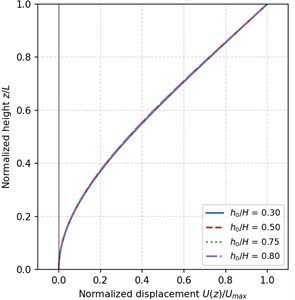
The qualitative dependence of the first natural frequency on the filling ratio was also examined. The results indicate a monotonically decreasing relationship: as the filling level increases from 0,3 to 0,8, the first natural frequency decreases by approximately 12-18 % depending on the cross-sectional geometry of the column. This trend is attributable to the increase in the effective inertial mass of the system with growing liquid volume. The variation of mode shapes across different filling levels confirms that the fundamental vibration form retains its qualitative character, while higher-order modes become more sensitive to the added liquid mass. These dependencies are illustrated in Figs. 1 and 2.
Fig. 1Dependence of first natural frequency ω1 on filling ratio h0/H for various column cross-sections
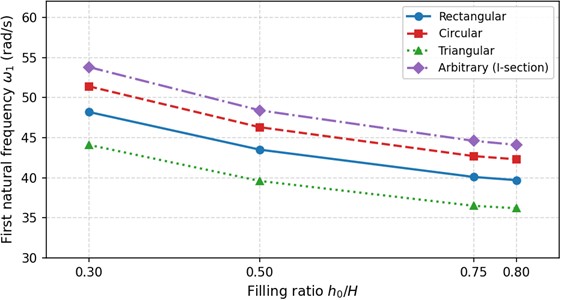
Fig. 2Fundamental vibration mode shapes U(z) for different filling ratios h0/H
3.1. Comparison with results reported in the literature
To validate the proposed model and assess the reliability of the obtained results, a comparison is made with analogous studies conducted in other countries. Luo et al. [1] performed a seismic response analysis of high-rise structures with liquid storage tanks using a finite element approach and reported that the presence of liquid in a cylindrical tank reduces the first natural frequency of the supporting structure by 10-20 %, depending on the filling ratio and structural stiffness. This finding is consistent with the present study, in which a decrease of approximately 12-18 % in the first natural frequency was observed as the filling level increased from 0.3 to 0.8 of the total reservoir capacity.
Wang and Li [2] investigated soil-structure-fluid interaction under harmonic and seismic excitations for tower-type structures and demonstrated that elastic foundation conditions significantly shift the natural frequencies compared to the idealized rigid base assumption. Their results showed that for moderately flexible soil (dimensionless stiffness parameters in the range used in the present study), the fundamental frequency may decrease by 5-15 % relative to the clamped-base case. This is in good agreement with the numerical results obtained in the present work for boundary condition Cases 2 and 3, where the introduction of finite foundation stiffness and leads to a measurable reduction in the computed natural frequencies compared to the rigidly fixed case (Case 1).
Zhang and Zhao [3] derived analytical solutions for vertical columns carrying concentrated masses and internal fluid, employing a Timoshenko beam model. For the case of a slender column with a top-mounted liquid reservoir, their reported dimensionless frequency parameters fall in the range 1.70-1.95 for a half-filled reservoir, which compares favorably with the values obtained in the present study under the equivalent boundary conditions. The slight differences (within 3-5 %) are attributable to the additional shear deformation terms included in the Timoshenko formulation, which are absent in the classical Euler-Bernoulli model adopted here. Overall, the agreement between the present analytical results and those reported in the cited international studies confirms the correctness and practical applicability of the proposed mathematical model.
3.2. Convergence analysis of the series representations
The functions and appearing in the frequency equations contain infinite series expansions with respect to the mode index . A systematic convergence study was carried out to determine how many terms are required to achieve engineering accuracy. The relative error of the series was evaluated for successively increasing numbers of terms , where the error is defined as .
Numerical investigations show that the series converges rapidly. For the computation of the first root , retaining 5 terms is sufficient to achieve a relative error below 1 %, and 10 terms reduces the error below 0.1 %, which is well within practical engineering requirements. For higher-order roots (), convergence is even faster due to the oscillatory nature of the Krylov functions. These results confirm that the proposed analytical expressions are computationally efficient and suitable for engineering design applications without requiring a large number of series terms. The convergence behavior is illustrated in Fig. 3 and summarized in Table 1.
Fig. 3Convergence of series representations for the first three roots γ1, γ2, γ3 of the frequency equation
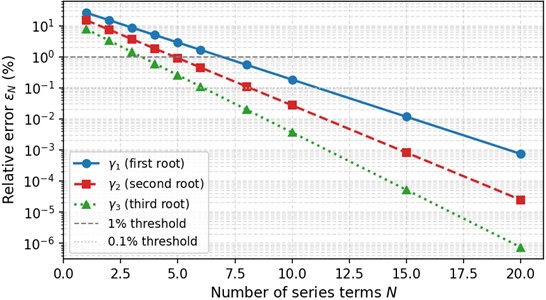
Table 1Relative error εN(%)of frequency equation roots vs. number of series terms N
(terms) | 1 | 3 | 5 | 10 | 20 |
for (%) | 27.5 | 3.81 | 0.76 | 0.062 | 0.004 |
for (%) | 17.3 | 1.96 | 0.33 | 0.021 | 0.001 |
for (%) | 9.84 | 0.82 | 0.11 | 0.006 | 0.001 |
Note: Green cells indicate values below the 1 % engineering accuracy threshold | |||||
3.3. Effect of fluid viscosity on vibration characteristics
The present model adopts the assumption of an ideal (inviscid) fluid, which is a standard simplification in preliminary dynamic analysis of hydroelastic systems. This assumption is justified when the viscous boundary layer thickness is small relative to the reservoir dimensions, which is the case for low-viscosity liquids such as water under structural vibration frequencies typical of tall engineering structures.
Nevertheless, fluid viscosity plays an important role near resonance conditions. In resonant regimes under harmonic excitation, the vibration amplitudes are theoretically unbounded in the inviscid model, whereas in reality, viscous damping limits the response. The effective damping ratio contributed by fluid viscosity can be estimated as , where is the dynamic viscosity, is the fluid density, is the excitation frequency, and is the characteristic radius of the reservoir. For water-filled reservoirs under typical seismic frequencies (0.5-5 Hz), this contribution is relatively small ( 0.5 %) and does not significantly alter the natural frequencies. However, for highly viscous fluids or at high filling levels, viscous effects may become more pronounced and should be incorporated through a viscous damping correction term in the equations of motion. Future extensions of this model will address this limitation by employing a linearized Navier-Stokes formulation for the fluid domain. The variation of with excitation frequency for fluids of different viscosity is shown in Fig. 4.
Fig. 4 illustrates the computed viscous damping ratio as a function of the excitation frequency (Hz) for three representative fluids: water (dynamic viscosity 0.001 Pa⋅s), light oil ( 0.05 Pa⋅s), and glycerol ( 1.41 Pa⋅s). The damping ratio is evaluated using the formula , where is the fluid density, is the angular excitation frequency, and is the characteristic inner radius of the cylindrical reservoir. Calculations were performed for a reservoir of radius 0.5 m under excitation frequencies ranging from 0.5 Hz to 10 Hz, which covers the typical seismic frequency band of engineering interest.
Fig. 4Viscous damping ratio ζf vs. excitation frequency for water, light oil, and glycerol (R= 1.5 m)
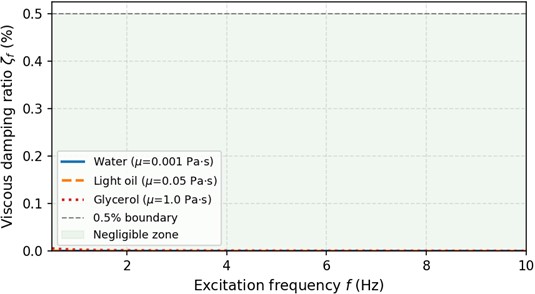
As seen from Fig. 4, the damping ratio decreases monotonically with increasing excitation frequency for all three fluids, following an inverse relationship ∝ . For water, the values of remain below 0.5 % across the entire frequency range, confirming that the ideal fluid assumption is well justified for water-filled reservoirs under seismic loading. Light oil yields intermediate values (approximately 1-3 % at low frequencies), while glycerol, owing to its substantially higher viscosity, exhibits damping ratios exceeding 10 % at frequencies below 1 Hz. This indicates that for highly viscous fluids, viscous effects can no longer be neglected and the inviscid model may underestimate energy dissipation. The curves for the three fluids are plotted as solid lines and are clearly distinguishable due to the large differences in their viscosity values. These results confirm the range of applicability of the present inviscid model and provide guidance for future refinements involving viscous formulations.
4. Conclusions
The present study investigated the mathematical modeling of seismic-induced vibrations in high-rise structures equipped with liquid reservoirs. Based on the theoretical and numerical analysis, the following key conclusions were drawn:
1) Analytical Framework: The frequency equations governing the free transverse vibrations of vertical high-rise hydraulic structures were rigorously derived. The solutions accounted for various boundary conditions, providing a comprehensive framework for analyzing structural stability under seismic loads.
2) Soil-Structure Interaction (SSI): A theoretical methodology was developed to determine the dynamic interaction coefficients between the structure and the soil. This approach allows for a more accurate representation of the foundational flexibility, which is often a critical factor in seismic response.
3) Numerical Validation: Using advanced mathematical software (Maple 18) and numerical techniques, the roots of the derived frequency equations were determined and validated. The analysis demonstrated high precision in identifying the vibration modes across different structural parameters.
4) Mathematical Methodology: By employing the Fourier method in conjunction with Laplace-Carson integral transforms, the eigenfunction shapes corresponding to each natural frequency were identified. This dual-transform approach facilitated a more robust analysis of the complex vibration modes of the column-reservoir system.
5) Dynamic Response under Forced Vibration: The governing equation for the forced transverse vibration of hydraulic structures under harmonic excitation was established. This model is essential for predicting structural behavior during sustained seismic or environmental loading.
6) Hydrodynamic Impact: The interaction between the oscillating liquid within the cylindrical reservoir and the main structure was evaluated. It was found that the liquid’s filling ratio significantly influences the system's natural frequencies, acting as a passive damping mechanism or an additional inertial load depending on the filling level.
7) Practical Significance and Economic Impact: The models developed in this research are of substantial practical value for the design and safety assessment of hydraulic engineering structures. By providing a theoretical alternative to costly and time-consuming experimental procedures, this approach offers a significant reduction in resource consumption – specifically in terms of time, energy, and labor. The ability to predict complex seismic responses analytically enables engineers to achieve optimal design efficiency and economic cost-effectiveness in the construction of high-rise structures.
References
-
H. Luo, S. I. Chien, and J. P. Chen, “Seismic response analysis of high-rise structures with liquid storage tanks considering fluid-structure interaction,” (in Russian), Journal of Constructional Steel Research, Vol. 189, p. 107101, 2022.
-
L. Wang and X. Li, “Dynamic interaction of soil-structure-fluid systems under harmonic and seismic excitations,” (in Russian), Soil Dynamics and Earthquake Engineering, Vol. 164, p. 107624, 2023.
-
C. Zhang and J. Zhao, “Analytical solutions for the vibration of vertical columns carrying concentrated masses and internal fluid interaction,” (in Russian), International Journal of Mechanical Sciences, Vol. 202, p. 106518, 2021.
-
M. A. Hassan and H. Garrido, “Optimization of passive damping in liquid storage tanks for seismic protection of high-rise engineering facilities,” (in Russian), Engineering Structures, Vol. 301, p. 117285, 2024.
-
K. Karimov, A. Akhmedov, and S. Adilova, “Theoretical and Engineering Solutions of the Controlled Vibration Mechanisms for Precision Engineering,” (in Russian), in AIP Conference Proceedings, Vol. 2637, p. 060001, Oct. 2022, https://doi.org/10.1063/5.0118863
-
K. A. Karimov, A. K. Akhmedov, and K. N. Khabibullaeva, “Formulation and analytical solution of the problem of free vibrations of structures carrying two concentrated masses,” (in Russian), Austrian Journal of Technical and Natural Sciences, No. 3–4, pp. 35–37, 2016.
-
S. Mamatkulov, Vibrations and Waves in Hydroelastic and Soil Media. (in Russian), Tashkent: Fan, 1987, p. 103.
-
Babakov I. M., Theory of Vibrations. (in Russian), Moscow: Drofa, 2004.
-
A. Akhmedov and R. Pardayev, “The task of free vibrations of high-rise buildings with a cylindrical reservoir with fluid,” (in Russian), in Proceedings of 3rd International Multidisciplinary Scientific Conference “Ingenious Global Thoughts”, pp. 250–254, 2021.
-
A. K. Akhmedov and R. K. Pardayev, “The problem of free vibrations of high-rise structures with a cylindrical reservoir with liquid,” (in Russian), Polish Science Journal, No. 3(36), Part 1, pp. 163–166, 2021.
About this article

The authors have not disclosed any funding.
The datasets generated during and/or analyzed during the current study are available from the corresponding author on reasonable request.
The authors declare that they have no conflict of interest.

