Abstract
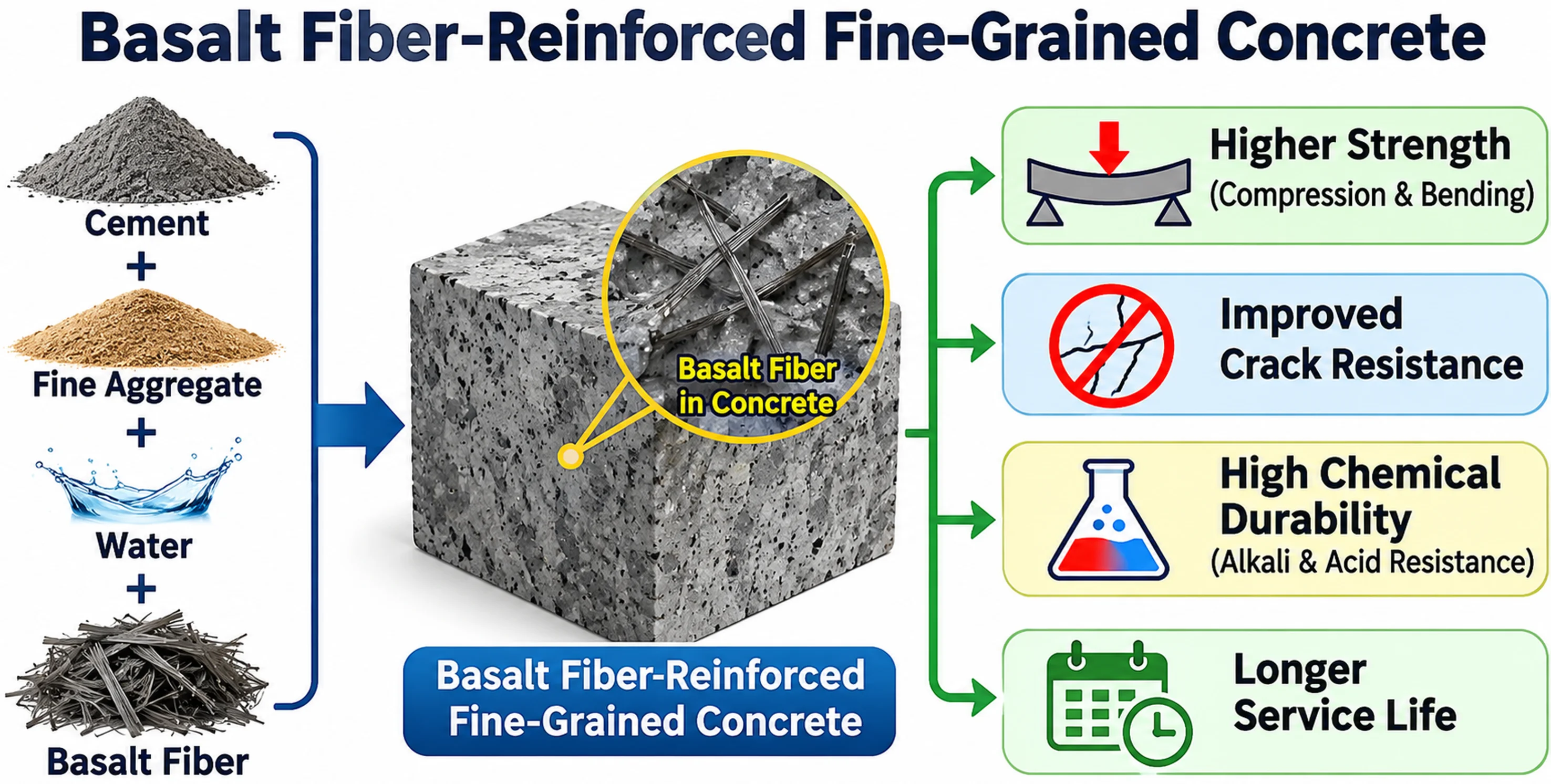
The creation of modern high-efficiency building materials and products, to which the demands are constantly increasing, can be successfully implemented using technologies using composite materials. Particularly promising are dispersed reinforced concrete, in which a strong matrix and reinforcing fibers are successfully combined. The matrix provides high compressive strength, bending strength, and durability, while dispersed fibers are characterized by significant tensile strength, high elastic modulus, and the ability to distribute loads throughout the entire volume. Such a combination increases crack resistance, improves the operational properties and durability of structures, and opens up new possibilities for use in modern engineering structures and industrial construction.
Highlights
- Basalt fibers exhibit high tensile strength (1600–3600 MPa) and enhance the crack resistance of fine-grained concrete.
- A basalt fiber content of 7% by binder mass was identified as the most effective concentration in the investigated mixtures.
- Basalt fiber mass loss increased during alkaline exposure, reaching 56.8% after 72 days.
- Basalt fibers retained more than 80% of their initial strength after 100 freeze–thaw cycles.
- Fiber chemical composition, Fe²⁺/Fe³⁺ ratio, and geometry influence the durability and reinforcing performance of basalt fibers.
1. Introduction
Studying the initial characteristics of different types of fibers will allow for the selection of the most effective component for dispersion reinforcement of fine-grained cement concretes from the point of view of the ratio of the achieved strength characteristics and the low cost of the designed structural material.
An analysis of the technical and performance characteristics of the primary types of fibers currently employed in the construction industry was conducted for the purpose of dispersed reinforcement of cement concrete (see Table 1) [1-3]. This assessment allowed for the ranking of available reinforcing fibers according to their efficiency in producing fine-grained, dispersed-reinforced concretes with specific, predetermined properties. By evaluating their mechanical behavior and compatibility with the cement matrix, it became possible to identify which fibers are most suitable for achieving enhanced strength, durability, and overall performance in reinforced concrete applications.
Based on the information presented in the table, basalt fiber outperforms many other types of fibers in a variety of key properties. In particular, it exhibits higher tensile strength than steel, which makes it an excellent option for reinforcing concrete structures. At the same time, basalt fiber has a lower relative elongation at break compared to steel, indicating that it stretches less before failure. Beyond its mechanical characteristics, basalt fiber shows strong chemical affinity with cement, ensuring better adhesion to the concrete matrix. This combination of high strength, chemical compatibility, and moderate flexibility enables basalt fiber to effectively minimize the formation and propagation of microcracks in concrete under stress, thereby improving the overall durability and longevity of reinforced concrete elements.
Analysis of the fiber characteristics given in Table 1 allows us to conclude about the prospects of using basalt fiber as an armoring component in the design of building composites.
Table 1Properties of various types of fibers
Fiber type | Density, kg/m3 | Strength at stretching, MPa | Elasticity modulus, MPa |
Polypropylene | 900 | 400-800 | 3500-8000 |
Polyethylene | 950 | 700 | 1400-4200 |
Nylon | 1100 | 770-900 | 4000 |
Acrylic | 1200 | 210-420 | 2100 |
Polyester | 1400 | 730-780 | 8400 |
Whole-headed | 1200 | 300-500 | 10000 |
Asbestos | 2600 | 1200-3100 | 160000 |
Glass | 2600 | 1050-3850 | 7000-8000 |
Steel | 7800 | 600-3150 | 200000 |
Carbonaceous | 2000 | 2000 | 245000 |
Carbonic | 1630 | 7800 | 380000 |
Polyamide | 900 | 720 | 1900 |
Viscose | 1200 | 660 | 5600 |
Basalt | 2700 | 1600-3600 | 7000-11000 |
Thus, according to the set of variable criteria, basalt fiber was chosen as a disperse-army component.
To justify the choice of the most effective basalt fiber for reinforcing the cement matrix, taking into account the wide geographical scope of its application in the construction industry, as well as the constantly increasing construction volumes in the territory of the Republic of Uzbekistan, an analysis of the basalt fiber of leading world manufacturers, whose annual production volume exceeds 1000 tons, was carried out.
Taking into account the set of initial characteristics, a comprehensive analysis of the raw mate-rial composition, the ratio of the geometric parameters of the fiber (length and diameter), as well as the applied technologies for its production, was carried out in order to more reasonably select basalt fiber.
Table 2Overview of basalt fiber properties from multiple manufacturers
Company | Technology | Raw materials | Diameter, μm |
“Qoraqalpoq Basaltwool LLC” LLC | centrifugal dispersion | silica-containing basalt (Si02 – 49 %) | 3-5 |
“DXO BAZALT” LLC Navoi | blowing the melt with a swirling stream of air | pyroxene porphyrite | 1-3 |
“Basalt Uzbekistan” LLC Karakalpak | duplex process | Basalt (Si02 – 52 %) | 1-3 |
“Basalt Uzbekistan” LLC Jizzakh | blowing the melt with a swirling stream of air | basalt (Si02 – 53 %) | 3-12 |
The chemical nature of a fiber is a key initial factor. Fibers that are largely silicate achieve stronger adhesion to cement, thanks to the alkaline conditions in the concrete matrix [4], [5].
The elemental composition of basalt fiber (Table 3) of various producers is characterized by insignificant variations in the concentrations of petrogenic elements. An exception is the increased content of magnesium and iron in the products of “Basalt Uzbekistan” LLC in Jizzakh and “Basalt Uzbekistan” LLC in Karakalpakstan. This may be a consequence of the increased content of olivine in the initial basalt raw material.
Despite the abundance of literature data [6], the question of the stability of basalt fiber in an aggressive environment still remains open. We studied the fibers of four manufacturers for acid and alkali resistance (Fig. 1).
Fig. 1Change in the pH of the solution depending on the type of fiber during testing for a) alkali resistance and b) acid resistance: Fiber No. 1 – LLC “Qoraqalpoq Basaltwool”, No. 2 – LLC “DXO BAZALT” Navoi, No. 3 – LLC “Basalt Uzbekistan” Karakalpak, No. 4 – LLC “Basalt Uzbekistan” Jizzakh
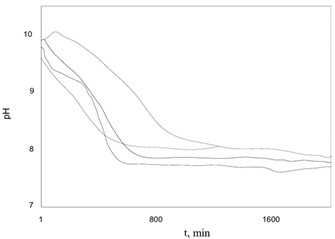
a)
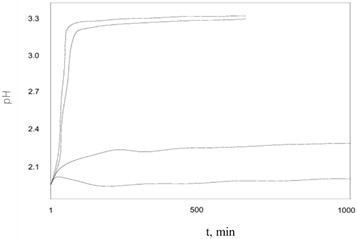
b)
Table 3Elemental composition of basalt fiber
Component | LLC “Qoraqalpoq Basaltwool LLC” | LLC “DXO BAZALT” Navoi | “Basalt Uzbekistan” LLC Karakalpak | LLC “Basalt Uzbekistan” Jizzakh |
Fiber No. 1 | Fiber No. 2 | Fiber No. 3 | Fiber No. 4 | |
Sodium (Na) | 1.81 | 3.3 | 2.3 | 1.62 |
Magnesium (Mg) | 3.07 | 1.8 | 1.8 | 2.62 |
Aluminum (Al) | 5.21 | 6.4 | 6.9 | 5.39 |
Silicon (Si) | 19.43 | 18.4 | 19.2 | 18.03 |
Phosphorus (P) | 0 | 0.2 | 0.2 | 0.23 |
Potassium (K) | 0.33 | 0.5 | 0.5 | 0.59 |
Calcium (Ca) | 3.1 | 3.2 | 2.9 | 3.21 |
Titanium (Ti) | 0.69 | 0.5 | 0.5 | 0.39 |
Marganese (Mn) | 0 | 0.1 | 0.1 | 0 |
Iron (Fe) | 3.64 | 4.2 | 3.5 | 7.05 |
Oxygen (O) | 62.19 | 18.4 | 19.2 | 17.03 |
Sulfur (S) | 0.46 | 0 | 0 | 0.02 |
2. Research methods and results
The most probable explanation for the obtained data may be the following. The chemical phenomena underlying the action of silica on the fiber consist in the transformation of silica into stable anions that do not polymerize in an alkaline medium: Si04 4~, Si205 2~, Si032~, and cations located in the vitreous phase form compounds of the zincate and aluminate type. If the solution is not renewed and the accumulation of decomposition products occurs, then the decomposition process slows down [7].
It is known that the process of basalt fiber destruction is influenced not only by the interaction of hydroxyl ions with silicon-oxygen groups, but also by the ability of the cation of the alkaline solution to exchange ions with the cations of metals that are part of the basalt fiber. When the alkali solution is in contact with basalt fiber, viscosity of the vitreous phase occurs first and only then destruction occurs. The rate of fiber breakdown is determined by the rate of transition of Na ions (modifier ion) into the solution [8].
The action of alkaline solutions begins with the adsorption of Na and OFT ions by the surface of the basalt fiber. As a result, an unstable compound is formed, which is broken down by the bonds ↓Si-O-SiO with the formation of the groups ↓Si-ONa and ↓Si-OH. After the destruction of a sufficiently large amount of Si-O-Si bond, the transition of the destroyed silicates to the solution begins. In the process of interaction of basalt fiber with alkaline solution, several stages are conventionally distinguished [9], [10]. First, adsorption occurs on the sheeloid surface of the basalt fiber. Then a so-called alkali attack takes place, which begins at surface defects and then spreads throughout the entire surface [11]: ≡Si-O-Si≡ + OH-> ≡Si-OH + ≡Si-C-.
In the final stage, the reaction products are removed from the surface of the fiber without forming a protective film. The chemical composition of the raw material used to produce basalt fibers plays a key role in determining their resistance to harsh environments. Specifically, incorporating structure-stabilizing oxides-such as zirconium, aluminum, iron, and tin-enhances the fiber’s strength by increasing its compactness. The technology and method of production also have a significant impact on fiber durability. All this in combination can determine possible submicronous heterogeneities associated with different Fe2+/Fe3+ content in the fiber. Figure 2 shows the Fe3+ content in the fibers obtained by the Mössbauer spectroscopy method.
Fig. 2Fe content in basalt fibers: 1-3 – LLC “Qoraqalpoq Basaltwool”, LLC “DXO BAZALT”; 4-6 – LLC “Basalt Uzbekistan” Karakalpak; 7-9, 10-12 – LLC “Basalt Uzbekistan” Jizzakh
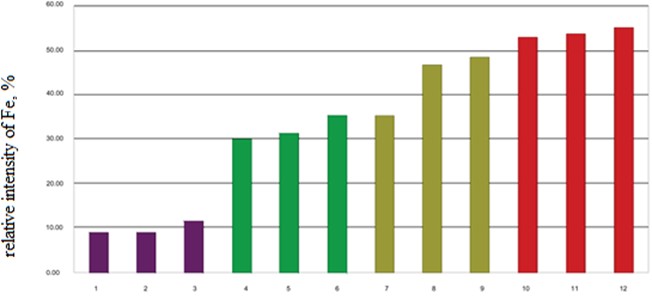
In Fig. 2, the horizontal axis represents the sample numbers (1-12) corresponding to different production batches of the four manufacturers, while the vertical axis shows the relative content of iron ions in different oxidation states.
According to a number of researchers [12-15], differences in the Fe2⁺ and Fe3⁺ concentrations in fibers promote the development of submicron heterogeneities, which are linked to iron atoms not incorporated into the silicon-oxygen framework. This structural feature decreases the oxidation resistance of the fibers and increases the likelihood of crystallization at elevated temperatures.
As previously mentioned, the geometric properties of fibers play a significant role in the design of dispersed reinforced materials. Literature sources indicate that achieving an optimal plastic-aggregate condition of the dispersed mixing component requires selecting initial materials with a length-to-diameter ratio exceeding 10 [13]. The analysis of the geometric characteristics of basalt fibers manufactured by LLC “Basalt Uzbekistan Jizzakh” confirms that these fibers possess the required proportions. Cement slurry with a high alkalinity (pH = 12.9) was employed as an aggressive environment. Pre-expanded basalt fibers were introduced into this solution (Fig. 3). The fiber content was determined considering the maximum permissible amount of basalt fiber in cement mixes, reported in the literature to range from 3 % to 12 % of the binder mass. In this study, a fiber content of 7 % was used.
The samples were stored at room temperature for 7, 14, 28, and 72 days. After the designated exposure periods, fibers were washed with a 0.1 % dilute hydrochloric acid solution using filter paper to remove cement matrix residues. To eliminate any remaining impurities, the samples were further rinsed with 1 liter of distilled water. The basalt fibers retained on the filter paper were then dried at room temperature until a constant weight was achieved.
Fiber solubility was evaluated by comparing the mass of the initial sample with the dry residue after exposure to the alkaline medium. Weight loss was expressed as a percentage (Table 4). Potential fiber losses during washing (termed technological losses) were assumed to be uniform across all experiments.
During observations on the 7th day, a slight formation of white precipitate was recorded on the surface of the basalt fiber, which is presumed to be related to the crystallization of calcium oxide (CaO) on the compacted surface of the fiber. In the interval from 14 to 28 and 62 days, due to the thinning of the smallest villi, the gradual destruction of the aggregated fiber clot occurred, accompanied by the slow deposition of finely dispersed fragments, the proportion of which reached about 20 % of the total mass.
Table 4Results of the study on the alkali resistance of basalt fiber
No. | Test time, days | Initial mass, g | pH starting | Weight after holding, g | Weight loss, % | pH after holding | Color |
1 | 7 | 4.67 | 11.9 | 4.17 | 12.4 | 11.9 | Norm |
2 | 14 | 4.95 | 11.9 | 3.45 | 24.2 | 11.5 | Norm |
3 | 28 | 5.01 | 11.9 | 3.31 | 29.9 | 11.5 | Slightly lit |
4 | 72 | 4.85 | 11.9 | 2.01 | 56.8 | 11.3 | Slightly lit |
By the 28th day, the amount of white precipitate increased significantly and spread mainly to larger fibers. During visual examination of the samples on the 72nd day, a change in the color of the fiber surface was observed: from a weakly lightened color in fine villi to a grayish tint in more massive elements.
In addition, to assess the long-term durability of basalt fiber under real environmental impacts, tests were also conducted under cyclic loading and freeze-thaw conditions. The frost resistance tests were carried out in accordance with GOST 10060-2012 (Basic method). These experiments showed that basalt fibers retain more than 80 % of their initial strength after 100 freeze-thaw cycles, indicating high resistance to microcrack propagation and structural degradation. The results confirm that basalt fiber maintains its reinforcing ability even after repeated temperature fluctuations and mechanical stresses [14], which is critical for its application in regions with continental and sharply variable climates.
3. Conclusions
Microstructure and mechanical properties: Basalt fiber is characterized by high tensile strength (1600-3600 MPa) and high elastic modulus (7000-11000 MPa). Although the relative elongation of the fibers is low, due to their chemical compatibility, they adhere well to the cement matrix and effectively prevent microcracks.
Chemical stability: fibers from various manufacturers were tested in a hydroxide and acidic environment. The results of storage from 7 to 72 days showed that the mass of the fibers decreases to a maximum of 50 %, but this process is slow and the fibers retain their mechanical properties. The silicate composition of the fibers and the Fe2+/Fe3+ ratio were noted as the main factors determining their stability.
Climate and mechanical resistance: Test results in cyclic loading and freezing-melting cycles showed that basalt fibers retain more than 80 % of their initial strength. This confirms their high resistance to the development of microcracks and structural degradation.
Optimal concentration and geometry: In the study, the maximum fiber content in the concrete composite was 3-12 %, and the best results were observed at a concentration of 7 %. A fiber length-diameter ratio of more than 10 ensures optimal mixing with the plastic and aggregate.
Practical conclusions: Basalt fiber can be used as a component of highly effective dispersed reinforcement due to its high mechanical strength, chemical stability, and good integration with cement. This ensures the long-term durability of concrete structures, especially in regions with a continental climate and frequent temperature fluctuations.
References
-
I. Mukhamataliyev, N. Mukhammadiev, F. Ruzmetov, A. Khudoyorov, and S. Uzakov, “Performance properties of fiber-reinforced concrete particle-fiber-reinforced fox polfiber M12 BASF companies,” in AIP Conference Proceedings, Vol. 3286, No. 1, p. 020003, Jun. 2025, https://doi.org/10.1063/5.0281474
-
H. Zhu, C. Wen, Z. Wang, and L. Li, “Mechanical properties and microstructure of basalt fiber-reinforced concrete: A comprehensive review,” Construction and Building Materials, Vol. 411, p. 134320, 2024.
-
M. Guo et al., “Degradation mechanism of basalt fibers in highly alkaline cementitious environments,” Journal of Building Engineering, Vol. 82, p. 108215, 2025.
-
N.M. Mukhammadiev and G. Malikov, “Use of basalt fiber in concrete mixture for manufacture of prefabricated concrete and reinforced concrete structures,” in AIP Conference Proceedings, Vol. 3317, No. 1, p. 030043, Jul. 2025, https://doi.org/10.1063/5.0266812
-
V. Tsoy, D. Abdullaeva, and N.M. Mukhammadiyev, “Influence of silica-containing additives on structure formation of composite cement binder for non-autoclaved aerated concrete,” in AIP Conference Proceedings, Vol. 3045, No. 1, p. 060019, Mar. 2024, https://doi.org/10.1063/5.0197488
-
Y. D. Tretyakov, A. V. Knotko, and V. I. Putlyaev, “Development of chemical methods for increasing the hydrolytic and thermal corrosion resistance of basalt glasses,” (in Russian), Russian Academy of Sciences, Moscow, 2007.
-
V. B. Babaev, A. V. Knotko, and A. V. Garshev, “Consideration of the possibility of using basalt fiber as a micro-reinforcing component in road cement concrete,” (in Russian), in Innovative Materials and Technologies (20th Scientific Readings), Vol. 4, pp. 25–27, 2011.
-
A. V. Garshev et al., “Oxidative corrosion of basalt fiber,” (in Russian), Corrosion: Materials, Protection, No. 7, pp. 33–39, 2005.
-
V. S. Rusakov, Fundamentals of Mössbauer Spectroscopy: Textbook. (in Russian), Moscow: Moscow State University, Faculty of Physics, 2011, p. 292.
-
A. G. Yuryev, R. V. Lesovik, and L. A. Panchenko, “Dispersed-reinforced fine-grained concrete using technogenic sand,” (in Russian), News of Higher Educational Institutions. Construction, No. 11, pp. 121–124, 2008.
-
V. V. Yadykina, “Control of formation processes and quality of building composites taking into account the surface state of dispersed raw materials,” (in Russian), Belgorod State Technological University named after V.G. Shukhov, Belgorod, 2009.
-
C. Raupov and G. Malikov, “Comparison of microcrack formation boundaries determined by complex of physical methods with long-term strength of expanded clay concrete under different types of stress state,” E3S Web of Conferences, Vol. 365, p. 02023, 2023, https://doi.org/10.1051/e3sconf/202336502023
-
C. Raupov and G. Malikov, “Creep in expanded clay concrete at different levels of stress under compression and tension,” E3S Web of Conferences, Vol. 365, p. 02008, Jan. 2023, https://doi.org/10.1051/e3sconf/202336502008
-
A. I. Adylkhodzhaev, I. M. Makhamataliev, I. A. Kadyrov, S. S. Shaumarov, and F. S. Ruzmetov, “To the Question of the Influence of the Intensity of Active Centers on the Surface of Mineral Fillers on the Properties of Fine-Grained Concrete,” International Journal of Innovative Technology and Exploring Engineering, Vol. 8, No. 9S2, pp. 219–222, Jul. 2019, https://doi.org/10.35940/ijitee.i1044.0789s219
-
S. Salikhanov and F. Zokirov, “Studying possibilities of joint operation of main beam and protective layer constructions,” in AIP Conference Proceedings, Vol. 3317, No. 1, p. 030029, Jul. 2025, https://doi.org/10.1063/5.0266815
-
V. Tsoy, F. Karimova, N.M. Mukhammadiyev, and J. Turgayev, “Parameters of the oscillatory process of the sleeper base in the area of the rail joint when using elastic spacers,” E3S Web of Conferences, Vol. 401, p. 05078, 2023, https://doi.org/10.1051/e3sconf/202340105078
-
V. Soy and V. Bekkulov, “Investigation of physical and mechanical properties of non-autoclaved aerated concrete from prescription and technological factors,” E3S Web of Conferences, Vol. 401, p. 03006, 2023, https://doi.org/10.1051/e3sconf/202340103006
-
S. Shaumarov, S. Kandakhorov, A. Babaev, and B. Kodirov, “Modeling development of optimal composition of non-autoclaved aerated concrete based on industrial waste,” E3S Web of Conferences, Vol. 401, p. 03011, 2023, https://doi.org/10.1051/e3sconf/202340103011
-
S. Shaumarov, K. Karakulov, S. Kandakhorov, Z. Okilov, and J. Yusupov, “Composition of aerated concrete using local raw materials,” in AIP Conference Proceedings, Vol. 3317, No. 1, p. 030047, Jul. 2025, https://doi.org/10.1063/5.0268040
-
N.M. Mukhammadiyev, Z. Sherafkan, and K. Nurali, “Field evaluation of the geotechnical behavior of lime-ground cushions in the Republic of Tajikistan,” Vibroengineering Procedia, Vol. 60, pp. 82–90, Dec. 2025, https://doi.org/10.21595/vp.2025.25706
-
A. Ilyasov, I. Mukhamataliev, N. Mukhammadiev, A. Nazibekov, and R. Auyezbayev, “Features of the structure formation of fine-grained concrete with polypropylene fiber FOX POLFIBER M12 from BASF company,” in AIP Conference Proceedings, Vol. 3331, No. 1, p. 040061, Nov. 2025, https://doi.org/10.1063/5.0306207
About this article

The authors have not disclosed any funding.
The datasets generated during and/or analyzed during the current study are available from the corresponding author on reasonable request.
The authors declare that they have no conflict of interest.

