Abstract
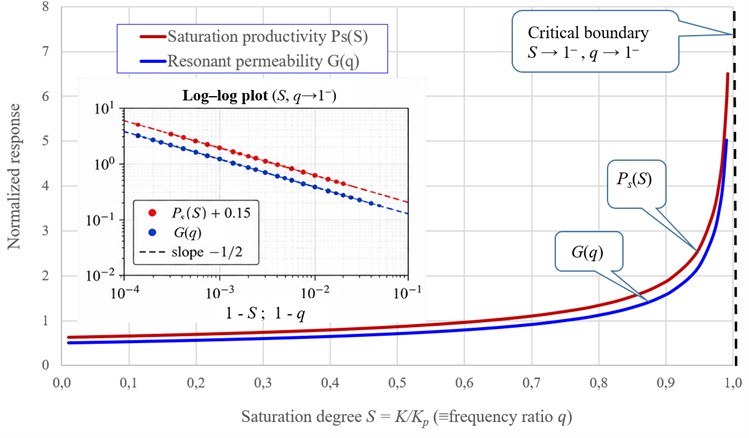
This paper examines the methodological relationship between the Vibroengineering School founded and scientifically led by Academician Kazimieras Ragulskis and Financial Saturation Theory (FST). Rather than transferring mechanical laws directly into economics, the study identifies structural parallels in nonlinear systems: nonlinearity, feedback, self-excitation, synchronization, resonance, and transitions between stable and unstable regimes. FST addresses a different class of systems but proposes a comparable qualitative mechanism: increasing saturation raises interaction density, strengthens feedback, and may generate synergy, self-synchronization, economic resonance, bifurcation, and financial instability. The paper adds a mathematical comparison of critical amplification based on the two response curves shown in Fig. 1. The saturation-productivity function and the normalized resonance-response function both exhibit square-root divergence as their respective normalized variables approach the critical boundary. Their leading critical exponent is therefore the same, although their coefficients, variables, and underlying mechanisms differ. This establishes an asymptotic structural correspondence, not dynamical isomorphism. The result refines the proposed methodological bridge and defines explicit limits on cross-disciplinary transfer. FST is presented as one possible interdisciplinary expression of a broader tradition of nonlinear systems thinking.
1. Introduction
The scientific school created by Academician Kazimieras Ragulskis (1926-2023) represents an important tradition in nonlinear mechanics and vibroengineering. Ragulskis’ own overview emphasizes vibrations, waves, nonlinear effects, and new principles of operation, reflecting a research programme in which the behaviour of a system cannot be reduced to simple proportional responses [1]. The Vibrotechnika centre at Kaunas Polytechnic Institute developed this systems-oriented tradition through theoretical modelling, experimental research, and engineering invention [2].
The present study asks whether some methodological principles developed for nonlinear mechanical systems can also illuminate nonlinear behaviour in economic and financial systems. The question requires caution. An economy is not a mechanical oscillator: economic agents form expectations, learn, imitate, compete, cooperate, and react to institutions. A direct transfer of mechanical laws into economics would therefore be unjustified.
Rejecting physical equivalence, however, does not exclude structural correspondence. Different complex systems may display comparable forms of feedback, endogenous amplification, synchronization, bifurcation, and regime transition. Financial Saturation Theory (FST) provides a useful case for examining this possibility. Its conceptual development proceeded from the logistic theory of capital management [3], through logistic analysis of sovereign-debt dynamics [4], to an explicit synthesis of Financial Saturation Theory [5] and subsequent empirical applications [6], [7].
The novelty of this study is developed in three steps: visual similarity, asymptotic correspondence, and a hypothesis of shared critical-amplification structure. The paper does not claim that mechanical resonance and financial bubbles are identical phenomena. Instead, it asks which methodological principles of nonlinear vibroengineering can be meaningfully generalized to saturated economic systems, whether the compared response functions share a local critical scaling, and where the limits of such cross-disciplinary transfer lie.
2. Methodological foundations of the vibroengineering school
2.1. Nonlinearity, feedback and self-excitation
A central feature of nonlinear dynamics is that system response depends not only on the magnitude of an external stimulus but also on the internal state of the system. The same excitation may produce a moderate response in one regime and a disproportionately large response in another. In vibration theory, feedback and self-excitation are especially important because sustained or increasing oscillations may be generated or maintained by internal mechanisms rather than by a continuously increasing external force [1], [8].
This distinction is methodologically important for economics. Asset-price growth, credit expansion, expectations, and investment can form positive feedback loops. An initial price increase can improve expectations; stronger expectations can attract investment; investment can then reinforce the price increase. The economic mechanism is not mechanical self-excitation, but in both cases the system’s internal dynamics become essential to explaining amplification.
2.2. Synchronization, resonance and stability
Synchronization changes aggregate behaviour because interacting elements cease to respond independently. General nonlinear-dynamics research has shown that coupled oscillatory systems can exhibit collective synchronization and phase locking [9], [10]. In vibroengineering, resonance and stability analysis similarly emphasize that the response of a system depends on the relation between excitation, internal modes, damping, and nonlinear interactions [1], [8].
The methodological lesson is broader than the mechanical definition of resonance: a system may remain apparently stable while internal parameters approach a critical region in which its response changes qualitatively. Instability can therefore emerge endogenously from the changing state of the system rather than exclusively from an external shock.
3. Financial saturation theory as a nonlinear economic framework
FST starts from the proposition that economic and financial activity develops within systems of limited capacity. The logistic-capital tradition provides the underlying language of capacity, saturation, and changing marginal response [3], [4], [11]. The 2024 monograph consolidates these ideas explicitly within Financial Saturation Theory [5]. At low saturation, additional activity can be absorbed relatively easily and conventional relations may provide acceptable approximations. As saturation rises, unused capacity diminishes, interactions become denser, and feedback among agents becomes more important.
The proposed FST sequence is: saturation → increasing interaction density → synergy → self-synchronization → economic resonance → bifurcation and instability. In this interpretation, saturation does not merely indicate scarcity. It changes the structure of interactions within the system. Decisions that could previously be treated as relatively independent become mutually dependent through prices, credit, expectations, imitation, and competition for constrained opportunities.
The theoretical development of this interpretation can therefore be traced from logistic capital management [3] and sovereign-debt analysis [4] to the explicit FST synthesis [5]. More recent applications identify high saturation and accelerated return dynamics in a green-stock market [6] and in the Enron bubble, where positive feedback, bifurcation thresholds, and a Natural Ponzi mechanism were analysed jointly [7]. These studies do not establish mechanical equivalence; they motivate the hypothesis that saturation can create conditions for endogenous nonlinear amplification.
Fig. 1Saturation productivity and resonant permeability. Red curve: saturation productivity PₛS. Blue curve: resonant permeability Gq. Inset: log-log comparison near the respective critical boundaries, S→ 1⁻ and q→ 1⁻, showing a common asymptotic slope of −1/2. Both responses exhibit inverse-square-root divergence with respect to their own normalized distance to the boundary; this local scaling correspondence does not imply dynamical isomorphism between the underlying systems
3.1. Critical amplification: asymptotic correspondence without dynamical isomorphism
Fig. 1 is generated from two explicit response functions contained in the underlying spreadsheet model. This makes it possible to move from a visual analogy to a direct asymptotic comparison. Let denote normalized saturation and let , with and fixed at the values used for the plotted series. For 2, the saturation-productivity function reduces to:
where 1, 0.75, 0.75, and the constant offset is 0.15. As approaches the capacity boundary, 1⁻, the numerator tends to the positive constant , whereas the denominator tends to zero. Therefore:
and, for 0.75 and 0.15,
The normalized resonant-permeability curve in Fig. 1 is generated by:
where denotes the normalized frequency ratio. Because , and the second factor tends to 4 as 1⁻,
The central result is therefore stronger than a resemblance of curve shapes: the two plotted response functions have the same local critical exponent, −1/2. Each diverges in proportion to the inverse square root of its own normalized distance from the corresponding boundary, although the prefactors, variables, and underlying mechanisms differ.
For the sole purpose of comparing the two local scaling laws, let z represent equal normalized distance to the respective boundaries (that is, in the saturation response and in the resonance response). The resulting asymptotic ratio is finite and non-zero:
Thus, under this common-distance normalization and sufficiently close to the respective critical boundaries, the two responses are asymptotically proportional. This is a comparison of local scaling, not an identification of S with q as physical quantities. No additional mapping such as is required; the fourth power already belongs to the definition of the resonance-response function itself.
This asymptotic proportionality is scientifically meaningful but it is not a proof of dynamical isomorphism. The variables S and q describe different physical and economic quantities, and the corresponding systems need not share state equations, conservation laws, feedback architecture, damping mechanisms, or phase-space structure.
A claim of dynamical equivalence would require a transformation that preserves the relevant dynamical invariants, including stability and bifurcation structure and, where applicable, phase-space topology.
The contribution established here is therefore deliberately narrower: the saturation-productivity and resonant-permeability responses belong locally to the same square-root critical-amplification class. This provides a mathematically explicit structural correspondence and a testable hypothesis for further cross-disciplinary research.
3.2. A minimal mathematical interpretation of nonlinear amplification
The asymptotic result above concerns response functions. A separate question is whether the underlying dynamics are comparable. For reference, a standard damped forced mechanical oscillator can be written as:
where is displacement, is the natural frequency, is the damping ratio, and is harmonic excitation. Its standard steady-state magnification factor depends on both frequency ratio and damping [8]. Accordingly, the comparison function used in Section 3.1 should be treated as the specific normalized response construction supplied for Fig. 1, not as a universal transfer function for a damped single-degree-of-freedom oscillator.
For comparison, a deliberately schematic positive-feedback process in finance may be written as:
where denotes an asset-price or capital-response variable, represents proportional growth, and represents endogenous reinforcement. Eq. (6) is not an FST saturation equation and is not proposed as an empirical asset-pricing model; it merely isolates a generic mechanism of nonlinear endogenous amplification.
Eqs. (5) and (6) therefore serve only as contrasting dynamical examples. The stronger result of this paper is not that these equations are equivalent, but that the normalized response constructions in Section 3.1 display the same square-root critical exponent and become asymptotically proportional near their respective normalized boundaries. Establishing a common normal form, matching bifurcation structure, or topological equivalence would require a separate dynamical analysis and is beyond the present paper.
4. From mechanical resonance to economic resonance
Table 1 and Fig. 2 summarize the proposed correspondence. The first link is nonlinearity: in both frameworks the response cannot be inferred from stimulus magnitude alone because the state of the system matters. The second is feedback: mechanical feedback changes subsequent motion, while financial feedback changes subsequent expectations and decisions. The third is endogenous amplification: a financial bubble, like a self-amplifying dynamical process, does not require a continuously increasing external impulse once internal feedback becomes sufficiently strong.
Fig. 2Methodological bridge from Vibroengineering to Financial Saturation Theory
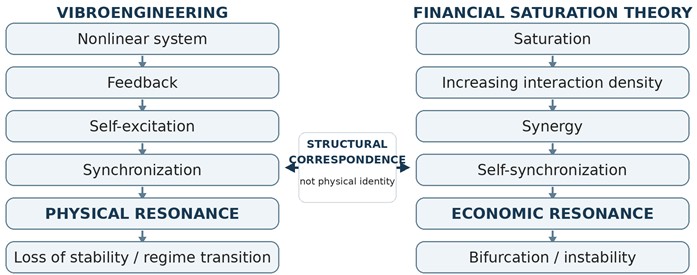
Table 1Structural correspondence between vibroengineering and financial saturation theory
Vibroengineering | Financial saturation theory |
Nonlinear response | Nonlinear economic response |
Feedback | Positive financial feedback |
Self-excitation | Endogenous amplification |
Synchronization | Self-synchronization of economic agents |
Mechanical resonance | Economic/financial resonance |
Loss of stability / regime transition | Bifurcation, bubble and crisis |
The fourth correspondence is synchronization. Under relatively low saturation, market participants may behave more independently. As interaction density rises, common prices, expectations, financing conditions, narratives, and imitation can synchronize behaviour. Individually rational responses may therefore become collectively destabilizing. The fifth correspondence is resonance. In this paper, economic resonance is used in a restricted operational sense: a hypothesized regime of endogenous amplification in which saturation-dependent interaction density, positive feedback, and partial synchronization generate a response disproportionate to the initiating perturbation. The term does not imply a literal equality between mechanical and economic frequencies. The final correspondence is regime transition: the amplified state can culminate in bifurcation, correction, bubble collapse, or another qualitative change in system behaviour.
5. Discussion: what can and cannot be transferred across disciplines
Cross-disciplinary comparison is scientifically useful only when its limits are explicit. Three levels should be distinguished. First, formal transfer concerns mathematical concepts – nonlinearity, stability, bifurcation, feedback, synchronization – that can be used in different domains when variables and assumptions are specified. Second, structural transfer concerns comparable organizational patterns or local scaling behaviour in systems with different physical or social foundations. Third, metaphorical transfer uses words such as ‘resonance’ descriptively without specifying an amplification mechanism.
The present argument is primarily one of structural transfer. Section 3.1 moves the comparison beyond visual metaphor by showing that the plotted saturation-productivity and resonant-permeability responses share the same square-root critical exponent and are asymptotically proportional near their respective normalized boundaries. This remains a local asymptotic result. FST does not claim that a market obeys the same equation as a mechanical oscillator. Economic agents are adaptive and reflexive; institutions and expectations alter the system itself. Mechanical damping cannot simply be relabelled as monetary policy, nor can a natural frequency be assumed to have a direct market equivalent.
The resulting hierarchy of evidence is therefore: visual similarity → asymptotic correspondence → hypothesis of shared critical-amplification structure. Only the first two steps are demonstrated here; the third is a research hypothesis. A future test would require independently defined saturation measures, feedback-strength and synchronization indicators, and instability thresholds across multiple markets, together with a dynamical analysis capable of comparing bifurcation or phase-space properties.
This hierarchy also refines the relationship between the Vibrotechnika tradition and FST. It would be excessive to describe FST as a direct consequence of vibroengineering. The stronger and more defensible claim is methodological continuity: attention shifts from isolated variables toward system states, from linear proportionality toward nonlinear response, from external shocks toward endogenous amplification, and from static equilibrium toward transitions between dynamical regimes. In this sense, the Ragulskis school represents a systems-oriented scientific culture whose conceptual reach may extend beyond particular vibration technologies.
6. Conclusions
The comparison leads to four conclusions. First, vibroengineering and FST investigate fundamentally different systems, yet both confront nonlinear response, feedback, synchronization, amplification, stability, and regime transition. Second, the central mathematical result is limited but nontrivial: the saturation-productivity function and the normalized resonant-permeability function plotted in Fig. 1 share the same square-root critical exponent, and their ratio tends to a finite non-zero constant as the respective normalized variables approach the critical boundary. Third, this asymptotic correspondence does not establish dynamical isomorphism; it supports a testable hypothesis of shared critical-amplification structure. Fourth, the broader legacy of the Vibrotechnika School can be interpreted not only through engineering achievements but also through a systems-oriented mode of reasoning in which response is nonlinear, feedback matters, stability is conditional, and internal interactions can generate qualitatively new regimes.
The next research step is empirical and dynamical rather than metaphorical: to test whether saturation measures, feedback strength, synchronization indicators, and instability thresholds display reproducible relationships across financial markets and whether any of these systems can be reduced to comparable normal forms or bifurcation structures. Such work would determine how far the present asymptotic bridge can be developed into a formally testable cross-disciplinary framework.
References
-
K. Ragulskis, “Some problems of nonlinear precise vibromechanics and vibroengineering (Summary),” Journal of Vibroengineering, Vol. 13, No. 3, pp. 590–618, 2011.
-
D. Pauliukaitis, E. Kibirkštis, and K. Ragulskis, “Problems of precise vibromechanics and vibroengineering,” Vibroengineering Procedia, Vol. 8, pp. 377–385, Oct. 2016, https://doi.org/10.21595/vp.2016.17733
-
S. A. Girdzijauskas, The Logistic Theory of Capital Management: Deterministic Methods. Vilnius, Lithuania: Transformations in Business & Economics, Vol. 7, No. 2 (Supplement A), 2008.
-
S. A. Girdzijauskas, Sovereign Debt Crisis: Logistic Analysis. Vilnius, Lithuania: Vilnius University Press, 2011.
-
S. A. Girdzijauskas, Economic Crises: Insights from Financial Saturation Theory. Vilnius, Lithuania: Vilnius University Press, 2024.
-
D. Karaša and S. A. Girdzijauskas, “Analysis of the green stock market bubble based on financial saturation theory,” Transformations in Business and Economics, Vol. 23, No. 3A (63A), pp. 920–937, 2024.
-
D. Karaša, Ž. Drabavičius, S. Girdzijauskas, and I. Mikalauskas, “Deconstructing the Enron Bubble: The Context of Natural Ponzi Schemes and the Financial Saturation Hypothesis,” Journal of Risk and Financial Management, Vol. 18, No. 8, p. 454, 2025, https://doi.org/10.3390/jrfm18080454
-
A. H. Nayfeh and D. T. Mook, Nonlinear oscillations. New York, NY, USA: Wiley, 1979.
-
Y. Kuramoto, Springer Series in Synergetics. Berlin, Heidelberg: Springer, 1984, https://doi.org/10.1007/978-3-642-69689-3
-
S. H. Strogatz, Nonlinear Dynamics and Chaos. Boulder, CO, USA: Westview Press, 2015.
-
P.-F. Verhulst, “Notice on the law that the population pursues in its increase,” Correspondance Mathématique Et Physique, Vol. 10, pp. 113–121, 1838.
-
A. Pikovsky, M. Rosenblum, and J. Kurths, Synchronization: a Universal Concept in Nonlinear Sciences. Cambridge, U.K.: Cambridge University Press, 2001.
-
R. M. Goodwin, “A growth cycle,” in Socialism, Capitalism and Economic Growth, London: Cambridge University Press, 1967, pp. 54–58, https://doi.org/10.1007/978-1-349-05504-3_12
-
H. P. Minsky, Stabilizing an Unstable Economy. New Haven, CT, USA: Yale University Press, 1986.
-
R. J. Shiller, Irrational Exuberance. Princeton, NJ, USA: Princeton University Press, 2015, https://doi.org/10.1515/9781400865536
About this article

The author has not disclosed any funding.
The datasets generated during and/or analyzed during the current study are available from the corresponding author on reasonable request.
The author declares no conflict of interest.

