Abstract
This study develops a constrained gradient-based optimization framework for the dynamic design of bidirectional porous functionally graded (FG) beams. Material properties are graded simultaneously along the thickness and width directions through independent power-law distributions, while even and uneven porosity patterns are considered. Touratier’s higher-order shear deformation theory (HSDT) is embedded directly in a constrained BFGS design loop so that the thickness power-law index (), width power-law index (), porosity coefficient (), and geometric aspect ratio (/) enter the design formulation simultaneously. The principal novelty is not the use of HSDT or BFGS separately, but their integration into a feasibility-aware framework in which the HSDT stiffness and inertia operators are recomputed during the design iterations and bound constraints together with a modal-stress screening criterion are enforced. The scalar objective combines natural-frequency enhancement and structural-mass reduction. To address the reviewers’ concerns about objective weighting and numerical differentiation, the revision adds explicit a-posteriori sensitivity audits using the archived response data and distinguishes these reproducible post-processing results from historical run metadata that were not preserved unambiguously. The archived performance cases include a fundamental frequency as high as 162.8 Hz, while the archived parameter sweep reports a 15-20 % mass-reduction trend relative to its reference state. These values are presented as performance cases rather than as proof of a unique weight-independent global optimum. The parametric phase-velocity results further demonstrate the strong coupling between bidirectional gradation and porosity. The framework therefore provides an interpretable route for linking spatial material tailoring, porosity, geometry, structural feasibility, and dynamic performance, with clear extensions toward vibration-transmission and vibroacoustic design.
1. Introduction
Functionally graded materials (FGMs) are advanced heterogeneous materials in which the mechanical, thermal, or physical properties vary gradually over one or more spatial directions. This continuous gradation reduces interfacial discontinuities and stress concentrations that are commonly observed in laminated composites. Foundational thermoelastic and structural formulations established the behavior of graded plates, cylinders, and related components under mechanical and thermal loading [1-7]. Consequently, FG concepts have been investigated for aerospace shielding, thermomechanical structures, and multidirectional beam applications in which stiffness, thermal resistance, durability, and mass efficiency must be balanced simultaneously [8-11].
Porosity is another important feature of FG structures. It may appear as a manufacturing imperfection, but it may also be deliberately introduced to reduce mass, improve energy absorption, or tailor dynamic performance. In porous FG beams, the local stiffness and inertia depend not only on the ceramic–metal volume fractions but also on the porosity distribution. Analytical, finite-element, and data-assisted studies consistently show that porosity distribution, foundation stiffness, boundary conditions, and shear modeling assumptions can substantially modify vibration, buckling, and effective shear response [12-18]. Recent higher-order and review studies further emphasize the importance of size effects and multidirectional porosity modeling [19-21]. These effects become more complex in bidirectional FG beams, where the material properties vary simultaneously along the thickness and width directions.
Accurate modeling of such structures requires a beam theory capable of representing transverse shear deformation without excessive simplifying assumptions. Classical Euler-Bernoulli beam theory neglects shear deformation, whereas first-order shear deformation theories generally require shear correction factors. Neutral-surface-based first-order theories and refined higher-order models have therefore been proposed to improve the representation of graded-beam kinematics and stress fields [22-25]. Touratier’s sinusoidal higher-order shear deformation theory provides a suitable framework because its kinematics reproduce a realistic transverse-shear distribution and satisfy traction-free conditions at the outer surfaces without an empirical correction factor [26]. Related HSDT formulations have been successfully applied to porous FG beams and plates in free-vibration and wave-propagation analyses [27-30].
Several studies have investigated the dynamic behavior of FG and porous FG beams and plates. Classical finite-element and analytical vibration solutions established the sensitivity of graded-beam frequencies to boundary conditions, slenderness, and material distribution [31-34]. Chen et al. [12] analyzed free and forced vibrations of shear-deformable porous FG beams, while Amoozgar and Gelman [35] studied rotating porous FG beams through an exact intrinsic formulation. Benadouda et al. [27] developed a shear deformation theory for wave propagation in porous FG beams. Batou et al. [28] and Bennai et al. [29] examined wave dispersion and dynamic responses of imperfect FG plates using higher-order theories. More recently, Dahmane et al. [30] and Debbaghi et al. [36] addressed bidirectional porous FG beams using higher-order formulations. These works provide important reference solutions for the dynamic response of porous FG structures.
The broader development of bidirectional FG beam mechanics includes plane-elasticity, semi-analytical, and symplectic formulations [37-40], free and forced vibration models for macro- and micro-scale beams [41-44], and static, buckling, and torsional analyses of sandwich beams, nanobeams, and nanotubes [45-47]. Energy-based dynamic formulations have also been applied to rotating FG beams and bidirectionally graded rotor–blade systems [35, 48, 49].
Recent analytical and finite-element developments have specifically treated sandwich, two-directional, and porous FG beams under bending, vibration, and buckling conditions [18-20, 50-54]. Together, these studies show that two-directional material variation can substantially alter stiffness, inertia, and modal characteristics, and therefore provide a strong basis for treating the two power-law indices as independent design variables.
The sensitivity of FG structural dynamics to localized stiffness degradation has additionally been demonstrated for cracked Timoshenko beams, multiple-crack systems, nonlinear open-crack vibration, rotating shafts, and bidirectional FG beams [55-59]. Recent wave-propagation analysis has also considered the combined effects of porosity and multiple cracks in bidirectional FG beams [60], and the vibration of two-dimensional porous FG beams with inclined cracks under thermo-hygro-mechanical coupling has been examined [61]. Although cracks are outside the present optimization model, this literature reinforces the need for stress-admissible designs and motivates future damage-aware extensions of the proposed framework.
Despite these advances, most available investigations remain primarily parametric. The porosity coefficient, power-law indices, and geometric ratios are typically prescribed in advance and their influence is then evaluated on natural frequencies or wave velocities. Optimization studies have shown that natural frequencies and mass can be tailored through bidirectional or axial material distributions [62, 63], while broader reviews document extensive optimization activity in FG structures [64]. Population-based alternatives, including genetic and hybrid PSO-GA strategies, are also widely used for constrained engineering optimization [65-68]. Although gradient-based structural optimization and failure-constrained material tailoring have been used in composite mechanics [69], comparatively less attention has been given to embedding a higher-order bidirectional porous-FG dynamic model directly inside a constrained quasi-Newton design loop. The BFGS family is attractive for this purpose because it updates curvature information from successive gradients rather than requiring explicit second derivatives [70, 71]. A recent complementary study on the same class of bidirectional porous FG beams employed a real-coded genetic algorithm and the explicit dynamic-efficiency objective , with design-domain sensitivity assessed through multiple admissible boxes [72]. In contrast, the present work investigates a gradient-based constrained BFGS formulation with a normalized frequency–mass scalarization, finite-difference gradients, Wolfe line search, and explicit feasibility screening. This distinction clarifies that the present contribution concerns a different optimization architecture and constraint treatment rather than a repetition of the population-based GA formulation.
The research gap addressed here lies at the intersection of two established streams: higher-order dynamic analysis of bidirectional porous FG beams and gradient-based constrained optimization. The novelty is therefore an integrated constrained-design formulation, rather than novelty of Touratier HSDT or the BFGS algorithm in isolation. Relative to predominantly parametric HSDT studies, the present formulation converts , , , and from prescribed analysis parameters into coupled design variables. Relative to earlier frequency-optimization studies of graded beams, the present framework simultaneously includes two-directional material gradation, an explicit porosity variable, Touratier shear kinematics, bound projection, and a stress-admissibility check inside the BFGS iterations. This establishes a direct computational link between spatial material tailoring, inertia redistribution, dynamic response, and design feasibility.
The broader engineering relevance extends beyond free-vibration optimization. Recent studies on lattice and triply periodic minimal surface (TPMS) metastructures have shown that tailoring stiffness, inertia, topology, and boundary conditions can strongly modify vibration transmission, wave propagation, and acoustic insulation [73-78]. These works are not used as direct validation of the present FG-beam model; rather, they establish a wider structural-dynamics context in which optimized stiffness-inertia distributions are exploited for vibration and noise control. Although fluid-structure coupling and acoustic radiation are outside the scope of the present formulation, the proposed HSDT-BFGS strategy provides a beam-level foundation for future vibroacoustic and metamaterial extensions.
The study is positioned within computational and structural mechanics, with direct relevance to structural dynamics, wave propagation, functionally graded materials, and constrained design optimization. Its emphasis is on mechanics-based modeling and reproducible numerical design rather than on a purely algorithmic optimization exercise.
The main contributions of this study are as follows:
– A bidirectional porous FG beam model is formulated with independent thickness- and width-wise gradation together with even and uneven porosity distributions.
– Touratier’s HSDT is used to derive the strain, stiffness, and inertia operators required for free-vibration and wave-propagation analysis.
– A constrained BFGS loop is coupled directly to the dynamic model so that , , , and are optimized simultaneously.
– Bound projection and stress admissibility are enforced during the iterative process to avoid infeasible mathematical optima.
– The revised discussion separates the physical mechanisms of stiffness and inertia redistribution from purely numerical convergence behavior and relates the framework to broader vibration-transmission and vibroacoustic design problems.
2. Material gradation and porosity model
A bidirectional porous FG beam of length , width , and thickness is considered. The beam is made from a ceramic phase, Si3N4, and a metallic phase, SUS304, a constituent pairing commonly used in benchmark studies of graded and porous structural members [30, 36]. The longitudinal coordinate is denoted by , the width coordinate by , and the thickness coordinate by . The coordinate ranges are , , and .
The ceramic volume fraction is assumed to vary according to the bidirectional power-law distribution, following the power-law modeling strategy widely used for one- and two-directional FG beams, rotor-blade systems, porous FG plates, and optimized graded structures [30, 42, 49, 59, 62, 64, 79, 80]:
where and are the power-law indices controlling the material gradation along the thickness and width directions, respectively. The metallic volume fraction is:
For an uneven porosity distribution, the porosity shape function is written as:
For an even porosity distribution, is used. The effective Young’s modulus and mass density are then expressed as:
where , , , and are the Young’s moduli and densities of the ceramic and metal constituents, respectively. The porosity coefficient controls the reduction induced by voids. The admissible range of is defined in the optimization constraints.
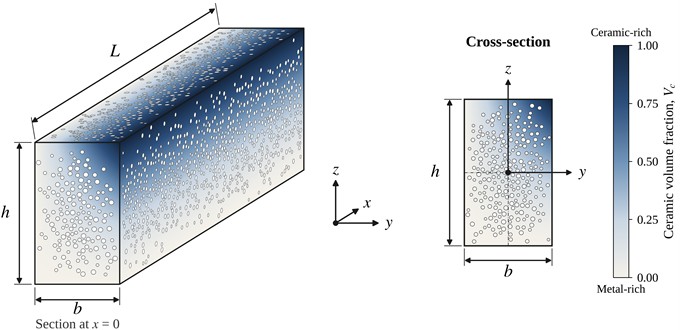
The bidirectional even and uneven porous configurations are shown in Figs. 1-2, respectively.
Fig. 1Schematic of a bidirectional FG beam with uniform porosity. The color scale represents the ceramic volume fraction, increasing from light (lower) to dark (higher)
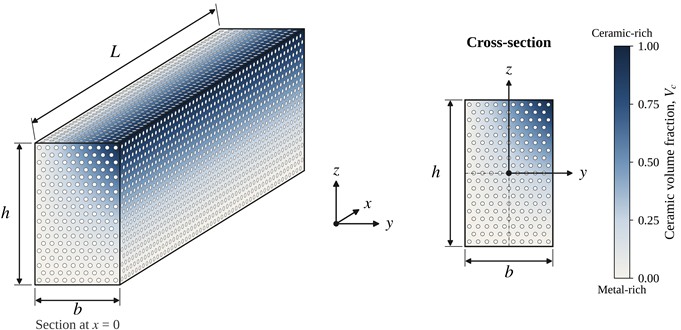
Fig. 2Schematic of a bidirectional FG beam with non-uniform porosity. The color scale represents the ceramic volume fraction, increasing from light (lower) to dark (higher)
3. HSDT-based dynamic formulation
3.1. Displacement field
According to Touratier’s HSDT [26], as adapted to porous FG beam dynamics in recent higher-order formulations [13, 36], the displacement field is written as:
where is the mid-plane axial displacement, is the bending component of the transverse displacement, and is the shear component of the transverse displacement. The Touratier shear shape function is taken as:
and its derivative gives:
The axial and transverse shear strains are therefore:
3.2. Energy expressions and stiffness coefficients
Hamilton’s principle, following the variational derivations commonly adopted in porous FG wave-propagation models [27, 29, 30], is used to obtain the governing equations:
The strain energy is:
where is the cross-section and assuming constant Poisson’s ratio . The kinetic energy is:
The stiffness coefficients entering the HSDT formulation are obtained from cross-sectional integrations:
The mass coefficients are similarly defined as:
Eqs. (15-19) explicitly define the origin of the stiffness and mass matrices used later in the eigenvalue problem. These coefficients are recomputed for each design vector during optimization because and depend on , , and .
3.3. Eigenvalue problem and phase velocity
Using the generalized displacement vector:
the governing equations can be written in matrix form as:
where is the design vector, is assembled from the stiffness coefficients in Eqs. (15-17), and is assembled from the mass coefficients in Eqs. (18-19). Non-trivial solutions require:
For wave propagation analysis, the phase velocity of mode is evaluated from the dispersion relation in the standard form used for porous FG beam and plate models [27, 28, 36]:
where is the wave number and is the corresponding circular frequency.
4. Constrained optimization framework
4.1. Design variables, objective function, and constraints
The design vector is defined as:
The four variables represent complementary mechanisms governing the dynamic response. The indices and independently control the through-thickness and width-wise material distributions, respectively; modifies the local stiffness and inertia fields through porosity; and controls the cross-sectional geometry. Treating and independently is essential for a bidirectional FG beam because the two spatial directions enter the stiffness and mass integrals differently.
The objective is to increase the fundamental natural frequency while reducing structural mass. The normalized scalar objective is:
where , is the structural mass, and are baseline values, and . The weights are preference parameters rather than material constants; changing them changes the relative value assigned to dynamic performance and mass. A documentation audit performed during revision showed that the archived numerical output does not preserve the exact per-run values of and . Rather than reconstructing unsupported metadata, the revised manuscript removes any claim that the archived response cases correspond to a specific unrecorded weight pair and reports an explicit a-posteriori sensitivity analysis for 0.20, 0.30, 0.40, 0.50, and 0.80 in Section 6.8. This makes the weight dependence reproducible and transparent while avoiding retrospective fabrication.
The structural mass is computed from:
The optimization is subject to:
The ranges , span weak-to-steep power-law gradations, defines the admissible range of the analytical porosity model adopted here, and spans moderately thick to slender cross-sectional configurations. These bounds define the design domain of the present study rather than universal material limits. For the archived response cases, the traceable values of , , and are all interior to their prescribed intervals; their normalized distances to the nearest bound are reported in Section 6.7. The archived geometric entry associated with is not reproduced in the revised response table because the surviving historical tabulation is inconsistent with the stated design domain, and no corrected value is inferred. In addition, the archived trade-off sweep is re-evaluated over reduced domains ( and ) to show explicitly when a mass-dominant scalarization becomes bound-active.
The axial normal stress associated with the HSDT strain field is evaluated as:
and the maximum stress is defined as:
where the maximum is evaluated over the longitudinal stations and cross-sectional quadrature points used in the numerical implementation. The generalized eigenproblem is solved with LAPACK DSYGV using the standard type-1 form . For this problem type, the returned eigenvectors are mass-normalized so that [81]. The first mass-normalized eigenvector is therefore used consistently to reconstruct and , removing the otherwise arbitrary modal amplitude from the numerical definition. The stress check is expressed through the normalized ratio . The admissibility constraint is therefore:
This formulation makes the modal stress indicator unique and reproducible for the adopted eigenproblem normalization. It remains a modal screening criterion, not a substitute for a service-load strength assessment under a prescribed external load. The normalized stress field is recomputed for every trial design before acceptance.
4.2. BFGS solution strategy
The BFGS algorithm approximates the Hessian of the objective without explicitly computing second-order derivatives. Unlike population-based searches previously applied to FG frequency optimization [62, 63, 65], the present quasi-Newton procedure uses local gradient and curvature information while enforcing feasibility. The positive-definite rank-two update follows the classical variable-metric developments of Fletcher and Goldfarb [70, 71]. At iteration , the search direction is obtained from:
where is the Hessian approximation.
The objective gradient is evaluated by a central finite-difference approximation:
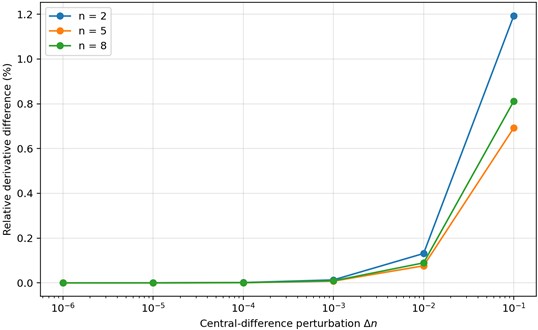
with the nominal perturbation 10-4. Finite differences can become expensive for high-dimensional problems; however, the present design space contains only four variables. A central-difference gradient therefore requires eight perturbed objective evaluations per iteration, in addition to the unperturbed evaluation. Central differences are retained because their leading truncation error is smaller than that of a one-sided forward approximation. The archived BFGS trace in Fig. 10 is retained only as a descent diagnostic and is not used to certify strict first-order convergence. A separate a-posteriori perturbation audit is reported in Section 6.9. It applies the same central-difference formula at three locations of a shape-preserving interpolation of the archived normalized frequency response (, 5, and 8) and demonstrates systematic convergence of the derivative estimate as the perturbation is reduced from 10-1 to 10-6. This isolates finite-difference accuracy from missing historical optimizer metadata and provides a reproducible sensitivity check for the adopted 10-4 perturbation.
The trial design is:
where the step length is determined using Wolfe conditions. The sufficient-decrease and curvature parameters are 10-4 and 0.9, respectively. After each trial step, the design vector is projected onto the admissible bound domain and the stress condition is checked before acceptance. The Hessian approximation is updated as:
with:
The iteration is stopped when:
or when the maximum number of iterations is reached.
Algorithm 1. Constrained BFGS optimization coupled with the HSDT dynamic model
Step 1. Define the initial design vector .
Step 2. Set , choose , , and .
Step 3. Compute and .
Step 4. Evaluate the stiffness and mass coefficients by cross-sectional integration.
Step 5. Assemble and .
Step 6. Solve .
Step 7. Compute , , , and .
Step 8. Approximate using central finite differences, Eq. (32).
Step 9. Solve .
Step 10. Perform a Wolfe-condition line search (10-4, 0.9) and project the design vector onto the bound domain.
Step 11. Accept only if the bound constraints and stress admissibility condition are satisfied.
Step 12. Update using Eq. (34).
Step 13. Set and repeat Steps 3-12 until the stopping criteria in Eq. (36) are satisfied or is reached; then stop.
5. Numerical implementation and verification
The numerical implementation follows Algorithm 1. For each candidate design, the material properties are updated using Eqs. (4-5); the cross-sectional stiffness and mass coefficients are evaluated using 8×8 Gaussian quadrature; and the generalized symmetric-definite eigenproblem is solved with the LAPACK routine DSYGV. The type-1 eigenvectors are mass-normalized, , consistent with the LAPACK convention [81]. Unless otherwise stated, the principal design and parametric calculations use a simply supported beam configuration with the Si3N4/SUS304 constituent pair and the geometric ratios specified for each case. The baseline configuration is , and together with normalize the objective function. The nominal central-difference perturbation is 10-4 and the Wolfe line-search parameters are 10-4 and 0.9.
Verification. Verification is reported case-by-case using the boundary condition, material data, porosity description, and geometry of the corresponding source benchmark. This wording is important because the reference by Dahmane et al. [30] concerns a cantilever configuration, whereas the principal optimization results of the present study are reported for a simply supported beam. The relative error is evaluated as:
where denotes either a natural frequency or a phase velocity.
To verify the stiffness and mass operators of Eqs. (15-19) and the eigenvalue solution, the present formulation was reduced to its one-directional, non-porous limiting case (, ), for which , and applied to a simply supported Al/Al2O3 beam ( 380 GPa, 3960 kg/m3, 70 GPa, 2702 kg/m3, 0.3). The nondimensional fundamental frequency is compared in Table 1 with the trigonometric shear deformation beam theory solution reported by Şimşek [82] for 5 and 20 and , 1 and 5. The maximum relative difference is 4×10⁻⁴%, which confirms the implementation of the Touratier kinematics and of the cross-sectional integrations.
The direct numerical checks in Table 1 are complemented in Section 6.10 by a broader cross-study robustness matrix covering alternative porosity distributions and boundary conditions. Direct percentage errors are reported only when the benchmark assumptions are case-matched; otherwise, the comparison is restricted to qualitative trend consistency to avoid invalid cross-model error claims. Further implementation details are given in the Appendix.
Table 1Case-matched verification of the present formulation: nondimensional fundamental frequency ω‾ of a simply supported Al/Al2O3 beam in the limiting case k=0, α=0
Benchmark | Boundary condition | Reference | Present | Error (%) | ||
Şimşek [82] | Simply supported | 5 | 0 | 5.15313 | 5.15314 | 0.0002 |
Şimşek [82] | Simply supported | 5 | 1 | 3.99067 | 3.99068 | 0.0001 |
Şimşek [82] | Simply supported | 5 | 5 | 3.39979 | 3.39980 | 0.0002 |
Şimşek [82] | Simply supported | 20 | 0 | 5.46036 | 5.46035 | 0.0003 |
Şimşek [82] | Simply supported | 20 | 1 | 4.20509 | 4.20507 | 0.0004 |
Şimşek [82] | Simply supported | 20 | 5 | 3.64838 | 3.64837 | 0.0004 |
6. Results and discussion
6.1. Effect of porosity coefficient on natural frequencies
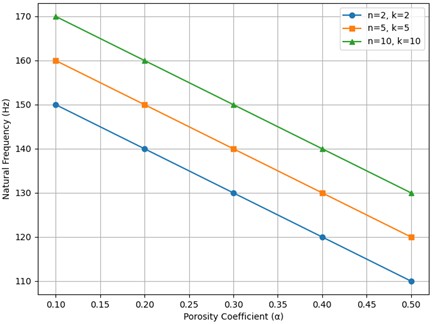
The porosity coefficient directly affects the stiffness and inertia distributions through Eq. (4-5). Increasing generally reduces the effective stiffness of the beam, which leads to lower natural frequencies when the stiffness reduction dominates the mass reduction. This trend agrees with previous porous-beam studies, while its magnitude remains sensitive to the assumed porosity pattern, elastic foundation, boundary conditions, and shear-deformation model [12-16, 18-20, 35]. Fig. 3 illustrates the variation of the natural frequency with the porosity coefficient for selected values of and .
Fig. 3Variation of the natural frequency with the porosity coefficient for selected bidirectional power-law indices
6.2. Effect of wave number and porosity distribution
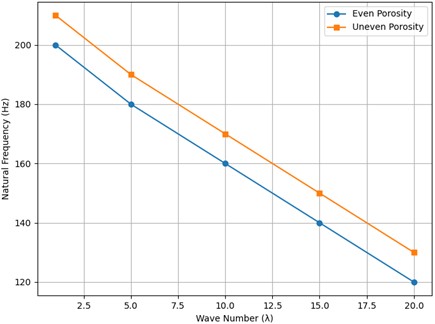
The wave number influences the modal dispersion characteristics of the beam. For the same design vector, even and uneven porosity distributions lead to different stiffness and inertia distributions over the cross-section. Comparable dispersion sensitivity has been reported for porous FG beams and imperfect FG plates under higher-order kinematics [27-30, 36]. Fig. 4 compares the wave-number-dependent frequency response for even and uneven porosity models.
Fig. 4Natural frequency variation with wave number for even and uneven porosity distributions
6.3. Effect of power-law indices
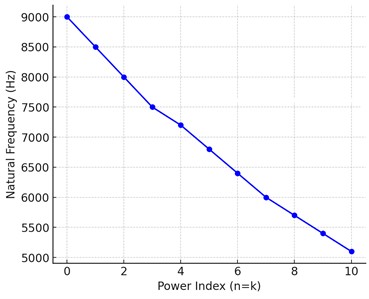
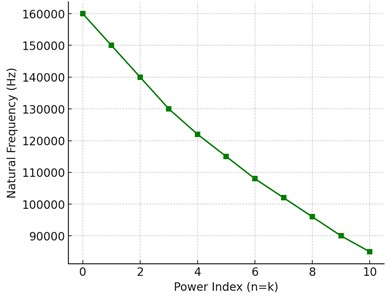
The power-law indices and control the ceramic-rich and metal-rich regions along the thickness and width directions. Their influence on the first two natural frequencies is shown in Figs. 5(a) and 5(b). Earlier one-directional and multidirectional studies likewise demonstrate that power-law indices interact strongly with porosity and thermal or geometric parameters [11, 19, 30, 41-44, 51, 53, 79, 80]. These results should therefore be interpreted together with the porosity coefficient because the optimized stiffness-to-weight response depends on the combined effect of gradation and porosity.
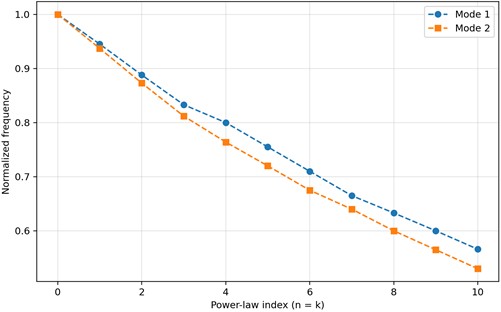
The frequency decrease with increasing power index should be interpreted together with the associated mass change. Fig. 6 shows the corresponding weight-reduction trend, while Fig. 7 compares the normalized modal trends. These complementary plots emphasize that the optimization is governed by a coupled stiffness-inertia balance rather than by frequency alone.
Fig. 5Natural frequencies versus the power-law index: a) first natural frequency, b) second natural frequency
a)
b)
Fig. 6Weight-reduction trend versus the power-law index for the investigated parameter sweep
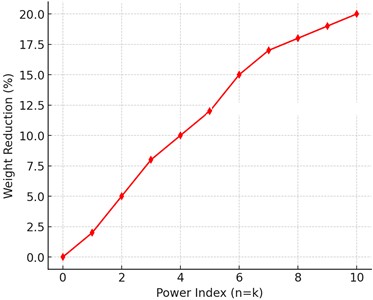
Fig. 7Normalized modal-frequency trends versus the power-law index
6.4. Phase velocity response
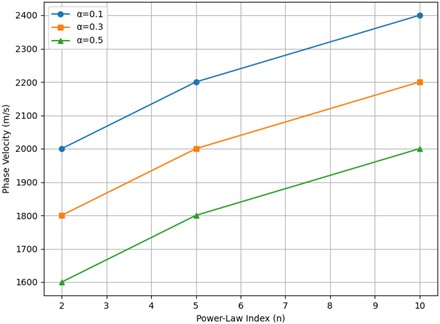
The phase velocity is computed from Eq. (23). Its variation with the power-law index reflects the combined influence of material gradation, porosity, wave number, scale effects, and, in broader service conditions, thermal fields [11, 27, 30, 36, 83]. Fig. 8 presents the phase velocity response for selected porosity coefficients.
Fig. 8Phase velocity variation with the power-law index for selected porosity coefficients
6.5. Stress admissibility
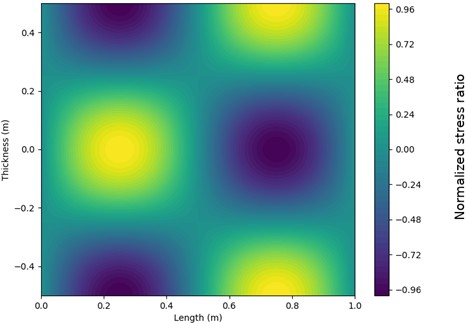
The stress constraint is evaluated using the dimensionless ratio in Eq. (30) and the mass-normalized first eigenvector defined in Section 4.1. A trial design passes the modal screening step when . Including such a criterion is consistent with failure-aware optimization strategies in composite mechanics, where frequency or stiffness improvement alone is insufficient to establish design admissibility [69]. Fig. 9 illustrates the dimensionless modal-stress ratio used in this screening. Because the quantity is modal and mass-normalized, it is interpreted as a reproducible comparative indicator rather than as a service-load strength prediction.
Fig. 9Dimensionless normalized modal-stress distribution σ^=σx/σallow used for the admissibility check
6.6. Optimization convergence
Fig. 10 reproduces the archived ten-iteration BFGS descent trace. The gradient norm decreases monotonically from 0.80 to 0.05, but the surviving log does not demonstrate the strict 10-4 first-order tolerance stated in the generic stopping rule. The revision therefore no longer uses this trace as proof of strict convergence or of a unique mathematical optimum. It is retained only as an algorithmic descent diagnostic, while Eq. (36) states the stopping rule required for a fully documented new run. The recorded gradient-norm values are listed in Table 2, and the archived performance cases retained from the original numerical campaign are summarized in Table 3.
Fig. 10Archived BFGS descent trace. The curve is reported as a monotonic descent diagnostic and is not used to claim strict first-order convergence
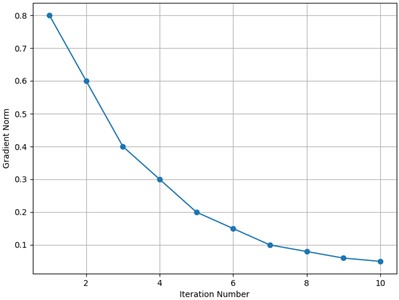
Table 2Archived gradient-norm descent trace for the ten recorded iterations
Iteration | |
1 | 0.80 |
2 | 0.60 |
3 | 0.40 |
4 | 0.30 |
5 | 0.20 |
6 | 0.15 |
7 | 0.10 |
8 | 0.08 |
9 | 0.06 |
10 | 0.05 |
Table 3Archived performance cases retained from the original numerical campaign. Only quantities that are unambiguous in the surviving record are reproduced; the historical b/h entries are omitted because they conflict with the declared 5≤b/h≤20 design domain and no corrected values are inferred.
Case | (Hz) | (kg) | |||
Performance case 1 | 2.5 | 1.8 | 0.30 | 150.2 | 12.5 |
Performance case 2 | 3.0 | 2.0 | 0.25 | 162.8 | 11.8 |
Performance case 3 | 2.8 | 1.9 | 0.28 | 158.4 | 12.0 |
6.7. Audit of prescribed design bounds
The rationale for the bounds is discussed in Section 4.1; here their influence is checked against the traceable archived response cases. For a scalar variable , the normalized distance to the nearest bound is defined as:
A value of zero indicates an active box constraint, while larger values indicate an interior point. Table 4 shows that the traceable , , and values are not located on their bounds. The historical entries are deliberately excluded for the provenance reason stated in Table 3. The archived one-dimensional sweep is also re-evaluated over and in Section 6.8; that comparison shows explicitly that a mass-dominant preference can become bound-active whereas a frequency-dominant preference remains at the high-frequency end of the explored response set.
Table 4Normalized distance to the nearest prescribed bound for the traceable archived design variables
Case | ||||||
1 | 2.5 | 1.8 | 0.30 | 0.250 | 0.180 | 0.400 |
2 | 3.0 | 2.0 | 0.25 | 0.300 | 0.200 | 0.500 |
3 | 2.8 | 1.9 | 0.28 | 0.280 | 0.190 | 0.440 |
6.8. A-posteriori sensitivity to objective weights
To address the dependence of the scalar objective on and without assigning unverifiable historical weights, the archived parameter sweep in Figs. 6-7 was reprocessed. The first normalized frequency branch and the normalized mass ratio were combined as:
where is the archived weight-reduction percentage. Table 5 summarizes representative preferences. The preferred point changes from the high-index, low-mass end of the archived sweep for mass-dominant weighting to the high-frequency end for frequency-dominant weighting. Thus, the preferred trade-off changes materially with the scalarization weights, and the revision does not claim a weight-independent optimum. This directly demonstrates why the weighting factors must be reported whenever a specific scalarized optimum is claimed. The same preference sensitivity is visualized in Fig. 11.
Table 5A-posteriori scalarization sensitivity evaluated from the archived frequency-mass parameter sweep
Preferred | |||||
0.20 | 0.80 | 10 | 0.566 | 0.800 | 0.5268 |
0.30 | 0.70 | 7 | 0.665 | 0.830 | 0.3815 |
0.40 | 0.60 | 0 | 1.000 | 1.000 | 0.2000 |
0.50 | 0.50 | 0 | 1.000 | 1.000 | 0.0000 |
0.80 | 0.20 | 0 | 1.000 | 1.000 | -0.6000 |
Fig. 11Preference sensitivity of the archived n=k frequency-mass sweep. The plot is an a-posteriori scalarization analysis of archived response data, not a retrospective reconstruction of missing BFGS weight metadata
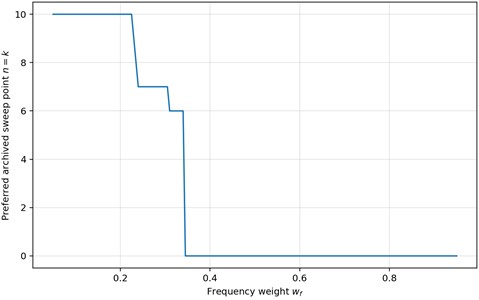
The same data also provide a direct design-domain check. For mass-dominant weights the preferred point moves toward the largest available power index, so reducing the domain from to changes the selected endpoint. For frequency-dominant weights the preferred point remains at . This confirms that bound sensitivity depends on the engineering preference and is explicitly reported rather than hidden inside the optimization setup.
6.9. Finite-difference perturbation consistency
A perturbation-size consistency check was performed at three locations of the archived normalized first-mode response, , 5, and 8. A shape-preserving piecewise-cubic interpolant was constructed from the archived points in Fig. 7, and the derivative was evaluated with the same central-difference expression as Eq. (32). Table 6 reports the maximum relative difference, over the three audit points, between the central-difference estimate and the derivative of the interpolant. The error decreases systematically as the perturbation is reduced. At 10-4 the maximum relative difference is approximately 1.33×10⁻³%, providing direct numerical support for the adopted perturbation on the smooth archived response. The reduction of the derivative discrepancy with decreasing perturbation is shown in Fig. 12.
Table 6Multi-point a-posteriori central-difference consistency audit. The reported value is the maximum relative derivative difference over n=2, 5, and 8
Maximum relative difference (%) | |
10-1 | 1.1931 |
10-2 | 0.1312 |
10-3 | 0.01324 |
10-4 | 0.001325 |
10-5 | 0.0001325 |
10-6 | 0.0000133 |
Fig. 12Finite-difference consistency at three archived response points. The monotonic reduction of the derivative discrepancy supports the use of Δxi= 10-4 for the smooth response audit
6.10. Robustness across porosity and boundary conditions
The direct verification in Table 1 is intentionally restricted to case-matched numerical comparisons. To broaden the robustness assessment without mixing non-equivalent models, Table 7 adds an independent trend-level comparison with studies that explicitly vary porosity pattern and boundary condition. The present trends are consistent with this literature: porosity distribution changes stiffness and inertia differently, boundary conditions materially shift the spectrum, and two-directional gradation interacts with porosity in determining the fundamental frequencies. This expanded comparison addresses robustness across modeling scenarios while preserving the distinction between quantitative verification and qualitative corroboration.
Table 7Cross-study robustness matrix. Quantitative errors are reserved for case-matched benchmarks; the rows below document independent trend consistency
Study | Scope relevant to robustness | Consistency with the present formulation |
Chen et al. [12] | Symmetric/asymmetric porosity, multiple boundary conditions, porosity coefficient and slenderness | Confirms that porosity pattern and boundary conditions materially change natural frequencies |
Turan and Adiyaman [19] | Porous two-directional FG beams, three porosity distributions, various boundary conditions | Supports the coupled influence of 2D gradation, porosity type and boundary condition |
Turan [20] | Porous bidirectional FG beams, three porosity types and multiple boundary conditions | Independently corroborates sensitivity of the fundamental frequency to porosity and support conditions |
Dahmane et al. [30] | Bidirectional porous cantilever beam, higher-order wave-propagation model | Bidirectional porous cantilever reference; its phase-velocity trends are used for qualitative comparison only |
6.11. Physical interpretation of the coupled dynamic changes
The simultaneous changes in frequency, mass, and phase velocity originate from the fact that stiffness and inertia do not weight the spatial material distribution in the same way. Structural mass is governed primarily by the cross-sectional integral of density, whereas bending-related stiffness coefficients contain spatial weighting terms such as . Consequently, changing and can redistribute the ceramic-rich phase toward mechanically influential regions and modify and the higher-order stiffness coefficients more strongly than the total mass.
In reduced form, the first natural frequency scales approximately as:
so a mass reduction does not by itself guarantee a frequency increase. Porosity introduces a second coupled mechanism because modifies both and . Even and uneven porosity distributions also place stiffness and inertia reductions in different regions of the cross-section. The optimizer therefore acts on the combined spatial redistribution of stiffness and inertia rather than on a single monotonic material parameter. The same redistribution enters the dispersion relation and explains the sensitivity of phase velocity to gradation and porosity.
This interpretation is consistent with the broader structural-dynamics literature in which stiffness-inertia tailoring is used to control vibration transmission and wave propagation. Recent lattice- and TPMS-based metastructure studies further demonstrate how spatial structural tailoring can affect acoustic transmission and vibration control [73-78]. The present beam formulation does not model fluid–structure interaction or acoustic radiation, but it provides a mechanics-based starting point for such extensions.
6.12. Comparison with existing studies
The present candidate response is placed in context with representative reference studies in Table 8. Because the listed models do not share all assumptions, this table is explicitly contextual and is not used as a validation table. Quantitative verification remains confined to Table 1.
The value 150.2 Hz for performance case 1 is approximately 24.6 % higher than the 120.5 Hz value listed for Benadouda et al. [27] and 15.5 % higher than the 130.0 Hz value listed for Batou et al. [28]. These percentages are reported as contextual performance differences, not as validation errors, because the reference formulations and structural models are not identical. Formal verification is restricted to case-matched comparisons such as those reported in Table 1.
Table 8Contextual comparison with representative reference studies. The comparison is not used as a direct validation unless all modeling assumptions are matched
Study | Model | (Hz) | |||
Benadouda et al. [27] | Porous FG beam | 0.2 | 5 | – | 120.5 |
Batou et al. [28] | Sigmoid FG plate | 0.3 | 7 | – | 130.0 |
Present performance case 1 | HSDT–BFGS framework | 0.30 | 2.5 | 1.8 | 150.2 |
6.13. Practical limitations and implications
The present framework assumes rule-of-mixtures effective properties, prescribed analytical porosity distributions, linear-elastic Touratier-HSDT beam kinematics, deterministic material parameters, and no explicit temperature-, moisture-, or damage-dependent constitutive evolution. These assumptions have direct practical implications. Temperature and moisture can modify constituent properties and therefore shift both the dynamic response and the design optimum [11, 17, 84]. Manufacturing scatter in porosity can move a deterministic optimum away from its nominal performance, motivating uncertainty quantification and robust optimization. The beam-level idealization also cannot resolve local three-dimensional stress concentrations, joints, detailed pore morphology, or manufacturing defects.
Finite-difference gradients are another numerical limitation: their cost grows with the number of design variables and their accuracy depends on the perturbation size. In the present four-variable problem this cost remains moderate, and the a-posteriori consistency audit in Section 6.9 shows stable differentiation of the archived smooth response at the nominal perturbation. Likewise, the scalar objective depends on the selected weights and ; the explicit sweep in Section 6.8 demonstrates that the preferred trade-off can change with the engineering preference. A Pareto formulation remains a natural future extension. Classical, multilayer, and - finite-element formulations provide established routes for extending the beam model to larger structural discretizations [52, 54, 85-88].
Accordingly, the archived performance cases should be interpreted as design responses produced within the stated deterministic beam framework, not as proof of a unique global optimum or as universally optimal manufactured components. Future work should address thermo-hygro-mechanical properties, porosity uncertainty, Pareto/robust optimization, damage sensitivity, high-fidelity finite-element analysis, and experimental validation.
7. Conclusions
A constrained gradient-based framework has been formulated for the dynamic design of bidirectional porous FG beams by embedding Touratier’s HSDT model inside a BFGS optimization loop. The principal novelty is the integrated treatment of the two independent gradation indices, porosity coefficient, cross-sectional aspect ratio, and stress feasibility within a single iterative design problem. This distinguishes the study from purely parametric HSDT analyses and from graded-beam optimization studies that do not simultaneously combine bidirectional porous gradation with stress-admissible higher-order dynamics.
The mechanics-based interpretation shows that the optimization acts on the spatially different contributions of stiffness and inertia. Redistribution of ceramic-rich material and porosity can change bending and shear stiffness coefficients at a different rate from total mass, thereby modifying the effective stiffness-to-inertia ratio and the dispersion response. The archived performance cases include natural frequencies up to 162.8 Hz, while the archived parameter sweep reports a 15-20 % mass-reduction trend relative to its reference state. These values are retained as performance evidence but are not presented as proof of a unique weight-independent optimum. The phase-velocity sweeps demonstrate strong sensitivity to the coupled gradation-porosity parameters.
The revised formulation also clarifies the numerical role of central finite-difference gradients, the Wolfe line search, the boundary conditions, and the normalized modal-stress admissibility calculation. The added archived-response audits show explicitly how scalarization weights and the finite-difference perturbation affect the reported trade-off and derivative consistency, while the cross-study robustness matrix extends the discussion to alternative porosity patterns and support conditions. Its broader relevance lies in stiffness-inertia tailoring for lightweight structural dynamics, with potential extensions toward vibration transmission, acoustic insulation, and metamaterial design. Future work should address Pareto multi-objective design, thermo-hygro-mechanical effects, uncertainty in porosity, damage sensitivity, fluid-structure coupling, and high-fidelity numerical/experimental validation.
References
-
J. N. Reddy and C. D. Chin, “Thermomechanical analysis of functionally graded cylinders and plates,” Journal of Thermal Stresses, Vol. 21, No. 6, pp. 593–626, 1998, https://doi.org/10.1080/01495739808956165
-
J. N. Reddy, “Analysis of functionally graded plates,” International Journal for Numerical Methods in Engineering, Vol. 47, No. 1-3, pp. 663–684, Jan. 2000, https://doi.org/10.1002/(sici)1097-0207(20000110/30)47:1/3<663::aid-nme787>3.0.co;2-8
-
J. W. Aliaga and J. N. Reddy, “Nonlinear thermoelastic analysis of functionally graded plates using the third-order shear deformation theory,” International Journal of Computational Engineering Science, Vol. 5, No. 4, pp. 753–779, 2005, https://doi.org/10.1142/s1465876304002666
-
E. Müller, Č. Drašar, J. Schilz, and W. A. Kaysser, “Functionally graded materials for sensor and energy applications,” Materials Science and Engineering: A, Vol. 362, No. 1-2, pp. 17–39, 2003, https://doi.org/10.1016/s0921-5093(03)00581-1
-
E.-S. Habib, M. A. El-Hadek, and A. El-Megharbel, “Stress analysis for cylinder made of FGM and subjected to thermo-mechanical loadings,” Metals, Vol. 9, No. 1, pp. 1–14, Dec. 2018, https://doi.org/10.3390/met9010004
-
M. Sid Ahmed Houari, A. Tounsi, and O. Anwar Bég, “Thermoelastic bending analysis of functionally graded sandwich plates using a new higher order shear and normal deformation theory,” International Journal of Mechanical Sciences, Vol. 76, pp. 102–111, 2013, https://doi.org/10.1016/j.ijmecsci.2013.09.004
-
H. L. Ton-That, “A combined strain element to functionally graded structures in thermal environment,” Acta Polytechnica, Vol. 60, No. 6, pp. 528–539, 2020, https://doi.org/10.14311/ap.2020.60.0528
-
X. L. Chen and K. M. Liew, “Buckling of rectangular functionally graded material plates subjected to nonlinearly distributed in-plane edge loads,” Smart Materials and Structures, Vol. 13, No. 6, pp. 1430–1437, Dec. 2004, https://doi.org/10.1088/0964-1726/13/6/014
-
S. A. Slimane et al., “Hypervelocity impact on honeycomb structure reinforced with bi-layer ceramic/aluminum facesheets used for spacecraft shielding,” Mechanics of Advanced Materials and Structures, Vol. 29, No. 25, pp. 4487–4505, Oct. 2022, https://doi.org/10.1080/15376494.2021.1931991
-
Z. Abdelhak, L. Hadji, T. H. Daouadji, and E. A. Bedia, “Thermal buckling of functionally graded plates using a n-order four variable refined theory,” (in Korean), Advances in Materials Research, Vol. 4, No. 1, pp. 31–44, 2015, https://doi.org/10.12989/amr.2015.4.1.31
-
M. E. A. Bourouis, M. Dahmane, M. Nebab, M. Benadouda, H. Ait Atmane, and R. Bennai, “Elastic wave propagation and dynamic response of multidirectional FG beams under varying thermal conditions,” Mechanics Based Design of Structures and Machines, Vol. 53, No. 12, pp. 8086–8110, Dec. 2025, https://doi.org/10.1080/15397734.2025.2505969
-
D. Chen, J. Yang, and S. Kitipornchai, “Free and forced vibrations of shear deformable functionally graded porous beams,” International Journal of Mechanical Sciences, Vol. 108-109, pp. 14–22, Jan. 2016, https://doi.org/10.1016/j.ijmecsci.2016.01.025
-
F. Mellal, R. Bennai, M. Avcar, M. Nebab, and H. A. Atmane, “On the vibration and buckling behaviors of porous FG beams resting on variable elastic foundation utilizing higher-order shear deformation theory,” Acta Mechanica, Vol. 234, No. 9, pp. 3955–3977, May 2023, https://doi.org/10.1007/s00707-023-03603-5
-
B. A. Medjdoubi et al., “On the effect of porosity on the shear correction factors of functionally graded porous beams,” (in Korean), Coupled Systems Mechanics, Vol. 12, No. 3, pp. 199–220, 2023, https://doi.org/10.12989/csm.2023.12.3.199
-
L. Hadji, F. Bernard, and N. Zouatnia, “Bending and free vibration analysis of porous-functionally-graded (PFG) beams resting on elastic foundations,” Fluid Dynamics and Materials Processing, Vol. 19, No. 4, pp. 1043–1054, 2022, https://doi.org/10.32604/fdmp.2022.022327
-
G. Adıyaman, “Free vibration analysis of a porous functionally graded beam using higher-order shear deformation theory,” Journal of Structural Engineering and Applied Mechanics, Vol. 5, No. 4, pp. 277–288, 2022, https://doi.org/10.31462/jseam.2022.04277288
-
S. Eiadtrong, N. Wattanasakulpong, and T. P. Vo, “Thermal vibration of functionally graded porous beams with classical and non-classical boundary conditions using a modified Fourier method,” Acta Mechanica, Vol. 234, No. 2, pp. 729–750, 2022, https://doi.org/10.1007/s00707-022-03401-5
-
M. Turan, E. Uzun Yaylacı, and M. Yaylacı, “Free vibration and buckling of functionally graded porous beams using analytical, finite element, and artificial neural network methods,” Archive of Applied Mechanics, Vol. 93, No. 4, pp. 1351–1372, Dec. 2022, https://doi.org/10.1007/s00419-022-02332-w
-
M. Turan and G. Adiyaman, “Free vibration and buckling analysis of porous two-directional functionally graded beams using a higher-order finite element model,” Journal of Vibration Engineering and Technologies, Vol. 12, No. 1, pp. 1133–1152, 2023, https://doi.org/10.1007/s42417-023-00898-5
-
M. Turan, “Mixed series solution for vibration and stability of porous bi-directional functionally graded beams,” Archive of Applied Mechanics, Vol. 94, No. 6, pp. 1785–1806, May 2024, https://doi.org/10.1007/s00419-024-02611-8
-
S. Zheng, N. Zhang, X. Zhao, D. Chen, and H. Wang, “Size-dependent mechanical analysis of porous functionally graded piezoelectric micro/nanoscale structures: A literature review,” Smart Materials and Structures, Vol. 33, No. 9, p. 093002, Sep. 2024, https://doi.org/10.1088/1361-665x/ad5809
-
M. Bouremana, M. S. A. Houari, A. Tounsi, A. Kaci, and E. A. Adda Bedia, “A new first shear deformation beam theory based on neutral surface position for functionally graded beams,” (in Korean), Steel and Composite Structures, Vol. 15, No. 5, pp. 467–479, 2013, https://doi.org/10.12989/scs.2013.15.5.467
-
L. Hadji, T. H. Daouadji, M. A. A. Meziane, Y. Tlidji, and E. A. A. Bedia, “Analysis of functionally graded beam using a new first-order shear deformation theory,” (in Korean), Structural Engineering and Mechanics, Vol. 57, No. 2, pp. 315–325, 2016, https://doi.org/10.12989/sem.2016.57.2.315
-
L. Hadji, Z. Khelifa, and E. A. A. Bedia, “A new higher order shear deformation model for functionally graded beams,” KSCE Journal of Civil Engineering, Vol. 20, No. 5, pp. 1835–1841, 2015, https://doi.org/10.1007/s12205-015-0252-0
-
Fouzia Larbi Chaht, Abdelhakim Kaci, Mohammed Sid Ahmed Houari, Abdelouahed Tounsi, O. Anwar Bég, and S. R. Mahmoud, “Bending and buckling analyses of functionally graded material (FGM) size-dependent nanoscale beams including the thickness stretching effect,” (in Korean), Steel and Composite Structures, Vol. 18, No. 2, pp. 425–442, 2015, https://doi.org/10.12989/scs.2015.18.2.425
-
M. Touratier, “An efficient standard plate theory,” International Journal of Engineering Science, Vol. 29, No. 8, pp. 901–916, 1991, https://doi.org/10.1016/0020-7225(91)90165-y
-
M. Benadouda, H. A. Atmane, A. Tounsi, F. Bernard, and S. R. Mahmoud, “An efficient shear deformation theory for wave propagation in functionally graded material beams with porosities,” (in Korean), Earthquakes and Structures, Vol. 13, No. 3, pp. 255–265, 2017, https://doi.org/10.12989/eas.2017.13.3.255
-
B. Batou, M. Nebab, R. Bennai, H. A. Atmane, A. Tounsi, and M. Bouremana, “Wave dispersion properties in imperfect sigmoid plates using various HSDTs,” (in Korean), Steel and Composite Structures, Vol. 33, No. 5, pp. 699–716, 2019, https://doi.org/10.12989/scs.2019.33.5.699
-
R. Bennai, H. Fourn, H. A. Atmane, A. Tounsi, and A. Bessaim, “Dynamic and wave propagation investigation of FGM plates with porosities using a four variable plate theory,” (in Korean), Wind and Structures, Vol. 28, No. 1, pp. 49–62, 2019, https://doi.org/10.12989/was.2019.28.1.049
-
M. Dahmane, M. Benadouda, A. Fellah, A. Saimi, A. A. Hassen, and I. Bensaid, “Porosities-dependent wave propagation in bi-directional functionally graded cantilever beam with higher-order shear model,” Mechanics of Advanced Materials and Structures, Vol. 31, No. 26, pp. 8018–8028, Nov. 2024, https://doi.org/10.1080/15376494.2023.2253546
-
M. Aydogdu and V. Taskin, “Free vibration analysis of functionally graded beams with simply supported edges,” Materials and Design, Vol. 28, No. 5, pp. 1651–1656, 2006, https://doi.org/10.1016/j.matdes.2006.02.007
-
A. E. Alshorbagy, M. A. Eltaher, and F. F. Mahmoud, “Free vibration characteristics of a functionally graded beam by finite element method,” Applied Mathematical Modelling, Vol. 35, No. 1, pp. 412–425, 2010, https://doi.org/10.1016/j.apm.2010.07.006
-
G. Giunta, D. Crisafulli, S. Belouettar, and E. Carrera, “Hierarchical theories for the free vibration analysis of functionally graded beams,” Composite Structures, Vol. 94, No. 1, pp. 68–74, Aug. 2011, https://doi.org/10.1016/j.compstruct.2011.07.016
-
C. F. Lu, C. W. Lim, and W. Q. Chen, “Exact solutions for free vibrations of functionally graded thick plates on elastic foundations,” Mechanics of Advanced Materials and Structures, Vol. 16, No. 8, pp. 576–584, 2009, https://doi.org/10.1080/15376490903138888
-
M. Amoozgar and L. Gelman, “Vibration analysis of rotating porous functionally graded material beams using exact formulation,” Journal of Vibration and Control, Vol. 28, No. 21-22, pp. 3195–3206, Jun. 2021, https://doi.org/10.1177/10775463211027883
-
S. Debbaghi, M. Dahmane, M. Benadouda, H. A. Atmane, N. Bendenia, and L. Hadji, “Wave propagation of bi-directional porous FG beams using Touratier’s higher-order shear deformation beam theory,” (in Korean), Coupled Systems Mechanics, Vol. 13, No. 1, pp. 43–60, 2024, https://doi.org/10.12989/csm.2024.13.1.043
-
H. J. Ding, D. J. Huang, and W. Q. Chen, “Elasticity solutions for plane anisotropic functionally graded beams,” International Journal of Solids and Structures, Vol. 44, No. 1, pp. 176–196, 2006, https://doi.org/10.1016/j.ijsolstr.2006.04.026
-
T. H. Daouadji, A. H. Henni, A. Tounsi, and A. B. El Abbes, “Elasticity solution of a cantilever functionally graded beam,” Applied Composite Materials, Vol. 20, No. 1, pp. 1–15, 2012, https://doi.org/10.1007/s10443-011-9243-6
-
C. F. Lü, W. Q. Chen, R. Q. Xu, and C. W. Lim, “Semi-analytical elasticity solutions for bi-directional functionally graded beams,” International Journal of Solids and Structures, Vol. 45, No. 1, pp. 258–275, Sep. 2007, https://doi.org/10.1016/j.ijsolstr.2007.07.018
-
L. Zhao, W. Q. Chen, and C. F. Lü, “Symplectic elasticity for bi-directional functionally graded materials,” Mechanics of Materials, Vol. 54, pp. 32–42, Jun. 2012, https://doi.org/10.1016/j.mechmat.2012.06.001
-
M. Şimşek, “Bi-directional functionally graded materials (BDFGMs) for free and forced vibration of Timoshenko beams with various boundary conditions,” Composite Structures, Vol. 133, pp. 968–978, Aug. 2015, https://doi.org/10.1016/j.compstruct.2015.08.021
-
Z.-H. Wang, X.-H. Wang, G.-D. Xu, S. Cheng, and T. Zeng, “Free vibration of two-directional functionally graded beams,” Composite Structures, Vol. 135, pp. 191–198, Sep. 2015, https://doi.org/10.1016/j.compstruct.2015.09.013
-
D. K. Nguyen, Q. H. Nguyen, T. T. Tran, and T. Bui, “Vibration of bi-dimensional functionally graded Timoshenko beams excited by a moving load,” Acta Mechanica, Vol. 228, No. 1, pp. 141–155, 2016, https://doi.org/10.1007/s00707-016-1705-3
-
L. C. Trinh, T. P. Vo, H.-T. Thai, and T.-K. Nguyen, “Size-dependent vibration of bi-directional functionally graded microbeams with arbitrary boundary conditions,” Composites Part B: Engineering, Vol. 134, pp. 225–245, Sep. 2017, https://doi.org/10.1016/j.compositesb.2017.09.054
-
A. Karamanli, “Static behaviour of two-directional functionally graded sandwich beams using various beam theories,” New Trends in Mathematical Sciences, Vol. 2, No. 5, pp. 112–147, 2017, https://doi.org/10.20852/ntmsci.2017.161
-
M. Z. Nejad, A. Hadi, and A. Rastgoo, “Buckling analysis of arbitrary two-directional functionally graded Euler-Bernoulli nano-beams based on nonlocal elasticity theory,” International Journal of Engineering Science, Vol. 103, pp. 1–10, 2016, https://doi.org/10.1016/j.ijengsci.2016.03.001
-
L. Li and Y. Hu, “Torsional vibration of bi-directional functionally graded nanotubes based on nonlocal elasticity theory,” Composite Structures, Vol. 172, pp. 242–250, Mar. 2017, https://doi.org/10.1016/j.compstruct.2017.03.097
-
M. T. Piovan and R. Sampaio, “A study on the dynamics of rotating beams with functionally graded properties,” Journal of Sound and Vibration, Vol. 327, No. 1-2, pp. 134–143, Jul. 2009, https://doi.org/10.1016/j.jsv.2009.06.015
-
I. Bouzidi, A. Hadjoui, and A. Fellah, “Dynamic analysis of functionally graded rotor-blade system using the classical version of the finite element method,” Mechanics Based Design of Structures and Machines, Vol. 49, No. 7, pp. 1080–1108, 2021, https://doi.org/10.1080/15397734.2019.1706558
-
M. Turan and V. Kahya, “Free Vibration and Buckling Analysis of Functionally Graded Sandwich Beams by Navier’s Method,” Journal of the Faculty of Engineering and Architecture of Gazi University, Vol. 36, No. 2, pp. 743–757, 2021.
-
M. Turan, “Bending analysis of two-directional functionally graded beams using trigonometric series functions,” Archive of Applied Mechanics, Vol. 92, No. 6, pp. 1841–1858, Apr. 2022, https://doi.org/10.1007/s00419-022-02152-y
-
M. Turan and G. Adiyaman, “A new higher-order finite element for static analysis of two-directional functionally graded porous beams,” Arabian Journal for Science and Engineering, Vol. 48, No. 10, pp. 13303–13321, Mar. 2023, https://doi.org/10.1007/s13369-023-07742-8
-
G. Adiyaman and M. Turan, “Bending and buckling analysis of porous 2D functionally graded beams with exponential material property variation,” Iranian Journal of Science and Technology, Transactions of Civil Engineering, Vol. 49, No. 2, pp. 1359–1386, Jun. 2024, https://doi.org/10.1007/s40996-024-01508-4
-
M. Turan, V. Kahya, E. U. Yaylaci, and M. Yaylaci, “A shear deformable numerical approaches for the static analysis of bi-directional functionally graded beams,” (in Korean), Advances in Nano Research, Vol. 18, No. 2, pp. 143–162, 2025, https://doi.org/10.12989/anr.2025.18.2.143
-
L.-L. Ke, J. Yang, S. Kitipornchai, and Y. Xiang, “Flexural vibration and elastic buckling of a cracked Timoshenko beam made of functionally graded materials,” Mechanics of Advanced Materials and Structures, Vol. 16, No. 6, pp. 488–502, Aug. 2009, https://doi.org/10.1080/15376490902781175
-
T. Lien, N. T. Duc, and N. T. Khiem, “Free vibration analysis of multiple cracked functionally graded Timoshenko beams,” Latin American Journal of Solids and Structures, Vol. 14, No. 9, pp. 1752–1766, Oct. 2017, https://doi.org/10.1590/1679-78253693
-
B. Panigrahi and G. Pohit, “Study of non-linear dynamic behavior of open cracked functionally graded Timoshenko beam under forced excitation using harmonic balance method in conjunction with an iterative technique,” Applied Mathematical Modelling, Vol. 57, pp. 248–267, Feb. 2018, https://doi.org/10.1016/j.apm.2018.01.022
-
D. Gayen, D. Chakraborty, and R. Tiwari, “Finite element analysis for a functionally graded rotating shaft with multiple breathing cracks,” International Journal of Mechanical Sciences, Vol. 134, pp. 411–423, Oct. 2017, https://doi.org/10.1016/j.ijmecsci.2017.10.027
-
N. Hassaine, N. Touat, M. Dahak, A. Fellah, and A. Saimi, “Study of crack’s effect on the natural frequencies of bi-directional functionally graded beam,” Mechanics Based Design of Structures and Machines, Vol. 52, No. 1, pp. 375–385, Jan. 2024, https://doi.org/10.1080/15397734.2022.2113408
-
M. Benadouda, M. El Amin Bourouis, M. Dahmane, R. Bennai, H. Ait Atmane, and O. Safer, “Dynamic response of wave propagation in functionally graded beams with defects: Effects of porosity and cracks,” Acta Mechanica, Vol. 236, No. 3, pp. 2279–2296, Mar. 2025, https://doi.org/10.1007/s00707-025-04270-4
-
S. Debbaghi et al., “Vibration analysis of 2D porous functionally graded beams with inclined cracks under thermo‐hygro‐mechanical coupling,” Fatigue and Fracture of Engineering Materials and Structures, 2026, https://doi.org/10.1111/ffe.70454
-
A. J. Goupee and S. S. Vel, “Optimization of natural frequencies of bidirectional functionally graded beams,” Structural and Multidisciplinary Optimization, Vol. 32, No. 6, pp. 473–484, Oct. 2006, https://doi.org/10.1007/s00158-006-0022-1
-
G. C. Tsiatas and A. E. Charalampakis, “Optimizing the natural frequencies of axially functionally graded beams and arches,” Composite Structures, Vol. 160, pp. 256–266, Oct. 2016, https://doi.org/10.1016/j.compstruct.2016.10.057
-
S. Nikbakht, S. Kamarian, and M. Shakeri, “A review on optimization of composite structures. Part II: Functionally graded materials,” Composite Structures, Vol. 214, pp. 83–102, 2019, https://doi.org/10.1016/j.compstruct.2019.01.105
-
H. Garg, “A hybrid PSO-GA algorithm for constrained optimization problems,” Applied Mathematics and Computation, Vol. 274, pp. 292–305, 2015, https://doi.org/10.1016/j.amc.2015.11.001
-
S. Katoch, S. S. Chauhan, and V. Kumar, “A review on genetic algorithm: past, present, and future,” Multimedia Tools and Applications, Vol. 80, No. 5, pp. 8091–8126, Oct. 2020, https://doi.org/10.1007/s11042-020-10139-6
-
S. Mirjalili, “Genetic Algorithm,” in Evolutionary Algorithms and Neural Networks: Theory and Applications, Studies in Computational Intelligence, Vol. 780, Cham: Springer International Publishing, 2018, pp. 43–55, https://doi.org/10.1007/978-3-319-93025-1_4
-
A. Lambora, K. Gupta, and K. Chopra, “Genetic Algorithm – A Literature Review,” in International Conference on Machine Learning, Big Data, Cloud and Parallel Computing (COMITCon), pp. 380–384, 2019, https://doi.org/10.1109/comitcon.2019.8862255
-
S. Debbagui, A. Sahli, and S. Sahli, “Optimisation and failure criteria for composite materials by the boundary element method,” Mechanics, Vol. 23, No. 4, pp. 506–513, 2017, https://doi.org/10.5755/j01.mech.23.4.14881
-
R. Fletcher, “A new approach to variable metric algorithms,” The Computer Journal, Vol. 13, No. 3, pp. 317–322, Mar. 1970, https://doi.org/10.1093/comjnl/13.3.317
-
D. Goldfarb, “A family of variable-metric methods derived by variational means,” Mathematics of Computation, Vol. 24, No. 109, pp. 23–26, 1970, https://doi.org/10.1090/s0025-5718-1970-0258249-6
-
S. Debbaghi, M. Dahmane, and A. Boussaid, “Genetic-algorithm optimization of dynamic efficiency in bidirectional porous functionally graded beams,” Applied Sciences, Vol. 16, No. 18, p. 8989, Sep. 2026, https://doi.org/10.3390/app16188989
-
M. R. Zarastvand, S. G. Chegini, and R. Talebitooti, “Novel hybrid-stiffened cylindrical metastructures for broadband sound insulation,” International Journal of Mechanical Sciences, Vol. 326, p. 111866, Jul. 2026, https://doi.org/10.1016/j.ijmecsci.2026.111866
-
M. R. Zarastvand, M. Motavasselolhagh, M. N. Kararoodi, and R. Talebitooti, “Computational framework for acoustics of eccentrically oblique stiffened metashells,” International Journal of Mechanical Sciences, Vol. 315, p. 111442, Feb. 2026, https://doi.org/10.1016/j.ijmecsci.2026.111442
-
M. R. Zarastvand, E. Abdoli, and R. Talebitooti, “A lattice metamaterial-based sandwich cylindrical system for numerical simulation approach of vibroacoustic transmission considering triply periodic minimal surface,” Applied Mathematics and Mechanics, Vol. 46, No. 11, pp. 2035–2054, 2025, https://doi.org/10.1007/s10483-025-3314-9
-
E. Abdoli, M. R. Zarastvand, and R. Talebitooti, “Wave propagation numerical simulation approach based on a novel TPMS-based lattice metamaterial for improved vibration transmission of doubly curved sandwich systems,” Engineering with Computers, Vol. 41, No. 5, pp. 3737–3754, Aug. 2025, https://doi.org/10.1007/s00366-025-02181-5
-
M. Zarastvand, E. Abdoli, and R. Talebitooti, “Numerical simulation-based noise assessment computational strategy for lattice metamaterial sandwich shell structures with double curvature considering elastic boundary effect,” Journal of Sandwich Structures and Materials, Vol. 28, No. 5, pp. 788–816, 2026, https://doi.org/10.1177/10996362251409991
-
M. R. Zarastvand, M. Ghassabi, and R. Talebitooti, “Acoustic insulation characteristics of shell structures: A review,” Archives of Computational Methods in Engineering, Vol. 28, No. 2, pp. 505–523, Dec. 2019, https://doi.org/10.1007/s11831-019-09387-z
-
N. Wattanasakulpong and V. Ungbhakorn, “Linear and nonlinear vibration analysis of elastically restrained ends FGM beams with porosities,” Aerospace Science and Technology, Vol. 32, No. 1, pp. 111–120, Dec. 2013, https://doi.org/10.1016/j.ast.2013.12.002
-
P. H. Cong, T. M. Chien, N. D. Khoa, and N. D. Duc, “Nonlinear thermomechanical buckling and post-buckling response of porous FGM plates using Reddy’s HSDT,” Aerospace Science and Technology, Vol. 77, pp. 419–428, 2018, https://doi.org/10.1016/j.ast.2018.03.020
-
E. Anderson et al., LAPACK Users’ Guide. Philadelphia, PA: Society for Industrial and Applied Mathematics, 1999, https://doi.org/10.1137/1.9780898719604
-
M. Şimşek, “Fundamental frequency analysis of functionally graded beams by using different higher-order beam theories,” Nuclear Engineering and Design, Vol. 240, No. 4, pp. 697–705, Jan. 2010, https://doi.org/10.1016/j.nucengdes.2009.12.013
-
P. R. Saffari, C. Thongchom, T. Jearsiripongkul, P. R. Saffari, S. Keawsawasvong, and S. Kongwat, “Porosity-dependent wave propagation in multi-directional functionally graded nanoplate with nonlinear temperature-dependent characteristics on Kerr-type substrate,” International Journal of Thermofluids, Vol. 20, p. 100408, 2023, https://doi.org/10.1016/j.ijft.2023.100408
-
A. S. Gawande, S. Kattimani, S. Murigendrappa, T. Nguyen-Thoi, H. Kamyab, and S. Althamer, “Free vibration analysis of a skew sandwich plate with bamboo biocomposite and polylactic acid core under temperature and moisture conditions,” Noise and Vibration Worldwide, Vol. 54, No. 9, pp. 434–459, 2023, https://doi.org/10.1177/09574565231193045
-
N. S. Bardell, “An engineering application of the h-p version of the finite element method to the static analysis of an Euler-Bernoulli beam,” Computers and Structures, Vol. 59, No. 2, pp. 195–211, 1996, https://doi.org/10.1016/0045-7949(95)00252-9
-
F. Ahmed, H. Abdelhamid, B. Brahim, and S. Ahmed, “Study of the effect of an open transverse crack on the vibratory behavior of rotors using the h-p version of the finite element method,” Journal of Solid Mechanics, Vol. 11, No. 1, pp. 181–200, 2019, https://doi.org/10.22034/jsm.2019.664228
-
V. Kahya and M. Turan, “Bending of laminated composite beams by a multi-layer finite element based on a higher-order theory,” Acta Physica Polonica A, Vol. 132, No. 3, pp. 473–475, Oct. 2017, https://doi.org/10.12693/aphyspola.132.473
-
V. Kahya and M. Turan, “Vibration and buckling of laminated beams by a multi-layer finite element model,” (in Korean), Steel and Composite Structures, Vol. 28, No. 4, pp. 415–426, 2018, https://doi.org/10.12989/scs.2018.28.4.415
About this article

The author has not disclosed any funding.
The author gratefully acknowledges the University of Adrar for providing academic support for this research.
The datasets generated during and/or analyzed during the current study are available from the corresponding author on reasonable request.
The author declares that he has no conflict of interest.

