Abstract
Optimization of technological equipment parameters allows the development of new efficient designs that can increase production profitability. In this article, the authors present the optimization of the inertial parameters of oscillating masses in a two-mass resonant vibration stand with an unbalance drive. The criterion for the optimization of the inertial parameters of the oscillating masses is the minimization of the power consumption of the electric motor that drives the unbalance. Based on the authors' own scientific developments, analytical dependencies were used to determine the amplitudes of mass oscillations, the stiffness coefficient of the elastic unit, force characteristics, and the unbalance parameters. The dynamic coefficients of the oscillating masses were also determined. These inertial-stiffness, force, and dynamic parameters, expressed as functions of one of the oscillating masses, were used in solving the optimization problem. As a result of solving the optimization problem, it was established that any two-mass oscillatory system with an unbalance drive has an optimal ratio of oscillating masses depending on the resonant tuning of the system. The further the circular frequency of forced oscillations deviates from the resonance frequency, the smaller the oscillating mass on which the unbalance is installed should be compared to the mass that performs the functions of the working body. In near-resonant pre-resonance operating modes, the inertial parameters of the two oscillating masses should be almost identical. It is at such ratios of inertial parameters that the electric motor consumes the minimum amount of power.
Highlights
- As a result of solving the optimization problem, it was established that:
- – for a two-mass oscillatory system with an inertial exciter, there exists an optimal ratio of oscillating masses that depends on the resonant tuning of the system;
- – the greater the deviation of the circular frequency of forced oscillations from the resonance frequency, the smaller should be the oscillating mass carrying the unbalance exciter relative to the mass performing the function of the working body;
- – in near-resonant operating conditions, the inertial parameters of the two oscillating masses should be approximately equal.
1. Introduction
In modern production of test stands, two-mass vibration systems equipped with unbalanced vibration exciters are being used with increasing frequency. A feature of such stands is their operation in a pre-resonant mode relative to the system’s natural frequency of oscillation. The use of a pre-resonant mode provides a number of important advantages, including increased energy efficiency of such technological equipment.
The pre-resonant mode of operation allows for a significant reduction in the energy consumption of the oscillatory system, since maintaining the required amplitude of oscillations requires considerably less power compared to single-mass non-resonant oscillatory systems. This is explained by the fact that two-mass oscillatory systems operate with an increased dynamic coefficient, due to which a significant part of the energy is accumulated and effectively used directly in the process of oscillatory motion. As a result, the drive energy is spent mainly on compensating for losses associated with damping and other resistive effects in the system.
The study of two-mass vibration stands is impossible without the analysis of dynamic processes occurring in their vibration systems. In recent years, there has been substantial progress in the development of analytical modeling methods, the investigation of nonlinear dynamics, multiparameter optimization, and numerical and experimental verification of two-mass resonant systems. Today, the main approaches to the calculation of mechanical vibration systems are described in sufficient detail in the educational, scientific, and technical literature [1, 2]. The significant contribution of many generations of researchers is summarized in reference publications for engineers and scientists [3]. Many works are devoted to the analysis of continuous vibration systems [4].
Based on existing theoretical and applied methods, researchers develop new designs of vibration technological machines [5], improve existing equipment by determining rational operating modes [6], implement optimal trajectories for the motion of working bodies [7], provide the necessary amplitude-frequency characteristics of vibration systems [8], investigate dynamic processes in unbalanced vibration exciters [9], and increase their operational performance [10]. Considerable attention is paid to the analysis of mathematical models of vibration machines [11], the study of complex dynamic phenomena [12], synchronization processes of inertial vibration exciters [13], as well as to improving their control algorithms [14]. The studies reported in [15, 16] are of particular interest to the authors, as they present a methodology for determining the parameters of vibration machines with eccentric drives. However, these studies do not address optimization problems.
A number of scientific groups have significantly expanded the classical approaches to the description of two-mass resonant systems with two degrees of freedom. One of the key works in this direction is the study [17], in which a mathematical apparatus was developed to describe the operation of an inertial vibration exciter in the frequency range close to the main resonance. The authors obtained analytical dependencies for determining the amplitude-frequency characteristics, phase trajectories, and for assessing the influence of the stiffness-to-mass ratio on the behavior of the system. The proposed approach allowed the direct determination of the optimal tuning parameters at which the maximum amplification of vibrations and the highest efficiency of the resonant system are achieved.
However, the authors did not address the problem of determining the optimal parameters of the oscillating masses. Therefore, based on the works [17-19], the authors aim to determine the optimal parameters of the oscillating masses in a two-mass resonant vibration stand with an unbalanced drive.
2. Description of the design and operation of the vibration stand
The vibration stand under study [17, 19] (Fig. 1) contains an active oscillating mass 1, with an inertia value of , and a reactive oscillating mass 2, with an inertia value of . The active oscillating mass 1 is connected to the reactive oscillating mass 2 through a resonant elastic node 3, having a stiffness coefficient . An unbalance 4 with a mass is mounted below the reactive oscillating mass 2 in a bearing assembly. The excitation force is applied to the reactive oscillating mass 2. The structure is mounted on a fixed base through vibration isolators 5, with a stiffness coefficient of . The vibration isolators are fixed to the active oscillating mass 1.
The oscillatory system is set in motion as follows. The rotor of the asynchronous electric motor 6 drives the input shaft of the hydraulic coupling 7. Rotational motion is transmitted from the output shaft of the hydraulic coupling to the unbalance 4 through the flexible clutch 8. Due to the forced rotation of the unbalance mass with the circular frequency , whose center of mass is located at an eccentricity r relative to the axis of shaft rotation, a time varying centrifugal force is generated, where the vector of the force amplitude rotates with the circular frequency . This results in a harmonic excitation force acting on the reactive oscillating mass 2 along the -axis. The motion of the reactive oscillating mass 2 is transmitted to the active oscillating mass 1 through the elastic node 3. Oscillating masses 1 and 2 move in antiphase with amplitudes and , respectively. It is assumed that the oscillations along the -axis are negligible; therefore, these motions are neglected.
Fig. 1Three-dimensional view of the resonant vibration stand, where: 1 – active oscillating mass (working body); 2 – reactive oscillating mass; 3 – resonant elastic unit; 4 – unbalance; 5 – vibration isolators; 6 – asynchronous electric motor; 7 – hydraulic coupling; 8 – flexible clutch; 9 – glider wing section subjected to cyclic loading
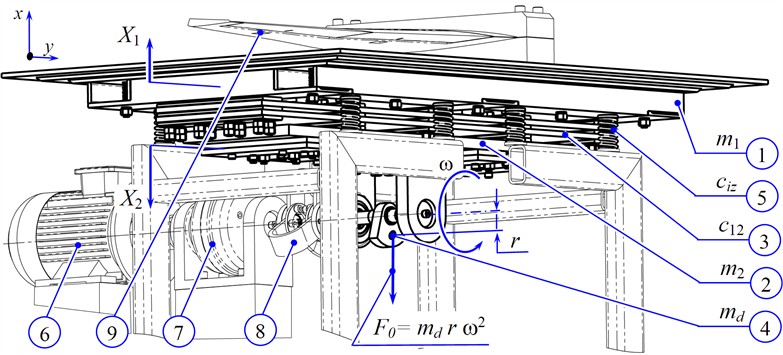
This design configuration assumes that the rotor of the asynchronous electric motor reaches its nominal operating conditions, while the rotational speed of the unbalance remains in the vicinity of the resonance peak due to processes associated with the Sommerfeld effect. This allows the frequency of forced oscillations to be automatically maintained near the pre-resonant region, thereby implementing energy-efficient operating modes in the vibration system of the stand. As a result, no expensive control systems are required.
The design of the vibration stand is intended for investigating cyclic loading conditions of aerospace structures. Fig. 1 shows a wing 9 fixed to the active oscillating mass 1, which performs the functions of the working body. However, for the sake of simplicity, the influence of the payload mass and the influence of vibration isolators 5 on the dynamic processes in the oscillatory system are neglected in the present study. The influence of properly selected vibration isolators on the dynamic behavior of the system is negligible. Including vibration isolators in the model alters the calculated vibration amplitudes by no more than 3 % [18]. Therefore, their stiffness is omitted from the subsequent analysis. Including the mass of the payload, represented by a wing rigidly cantilevered from the working body, significantly complicates the analysis. This issue requires a separate investigation, which the authors intend to conduct in future work.
3. Optimization problem
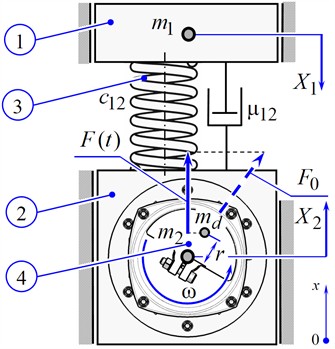
The mechanical oscillatory system shown in Fig. 2 is the subject of the present study and represents a simplified model of the resonant vibration stand illustrated in Fig. 1. The oscillatory system includes a viscous damping coefficient , which accounts for energy dissipation within the resonant elastic node.
Let the inertial value of the active oscillating mass 1 in the oscillatory system shown in Fig. 2 be 200 kg. It is assumed that the oscillatory system is excited by an unbalanced vibration exciter operating at a circular frequency of forced oscillations 150 rad/s. Furthermore, the technologically required amplitude of oscillations of the active oscillating mass 1 (working body) is assumed to be 2 mm. The inertial value of the reactive oscillating mass 2 is considered an unknown parameter. Then, the stiffness coefficient of the resonant elastic node 3, expressed as a function of the inertial value of the reactive oscillatory mass 2, is determined as follows [17, 18]:
where is the total mass of the two-mass oscillatory system, and is the resonant tuning parameter of the two-mass oscillatory system.
Fig. 2Idealized model of a two-mass oscillatory system with an unbalanced drive, where positions 1, 2, 3 and 4 correspond to the same components shown in Fig. 1
The viscous damping coefficient , expressed as a function of the inertial value of the reactive oscillating mass 2, is given by [17, 18]:
The static moment of unbalance , expressed as a function of the inertial value of the reactive oscillating mass 2 through the amplitude of oscillations of the active oscillating mass 1, is determined as follows [17]:
where ; . The oscillation amplitudes of the active mass 1 and reactive mass 2, expressed as functions of the inertial value of the reactive oscillating mass 2, are given by [17]:
where . The dynamic coefficients of the active mass 1 and reactive mass 2, expressed as functions of the inertial value of the reactive oscillating mass 2, are determined from the following expressions [17]:
The power required to drive the two-mass oscillatory system is determined from the following expression [17, 18]:
where is the overall efficiency of the drive system.
The optimization criterion (objective function) is the minimization of the motor power consumption, namely .
For the resonant tuning values 0.5; 0.6; 0.7; 0.8; 0.9; 0.96 and system parameters specified above, graphical dependences of the electric motor power consumption were constructed using Eqs. (1)-(9) and are presented in Fig. 3. As shown in Fig. 3, each value of the resonant tuning parameter corresponds to a specific value of the inertial parameter of the reactive oscillating mass 2 (Fig. 2), at which the motor power consumption reaches a minimum. Therefore, an optimal ratio between the inertial parameters of the two-mass oscillatory system always exists for a system excited by an inertial disturbance applied to the reactive mass.
Fig. 3Dependences of the electric motor power consumption on the resonant tuning parameter of the two-mass oscillatory system for m1= 200 kg, X1= 2 mm and ω= 150 rad/s
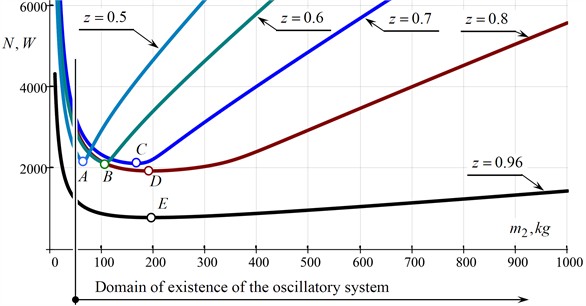
However, it should be noted that the reactive oscillating mass cannot be arbitrarily small, since the unbalanced rotor is mounted on this mass using bearing assemblies. In practice, when the active oscillating mass 1 is 200 kg, the reactive oscillating mass 2 must be at least 50 kg. The existence domain of the oscillatory system for this parameter ratio is shown in Fig. 3. The scientific results presented in this paper are theoretical in nature. The authors intend to experimentally validate these findings in future work.
The exact values of the optimal masses corresponding to each value of the resonant tuning parameter were determined using the Minimize function available in Mathcad software and are presented in Table 1.
Table 1Optimal inertia values m2 of the reactive oscillating mass as a function of the resonant tuning parameter z of the oscillatory system for m1= 200 kg, X1= 2 mm and ω= 150 rad/s
Inertial parameters of the oscillatory system | The importance of resonant tuning of an oscillatory system | ||||
0.5 | 0.6 | 0.7 | 0.8 | 0.96 | |
Inertial value of active oscillating mass, kg | 200 | ||||
Inertial value of the reactive oscillating mass, kg | 65.56 (point A) | 107.78 (point B) | 166.6 (point C) | 195.37 (point D) | 198.82 (point E) |
The ratio of the values of the inertial parameters of the oscillating masses, | 3.05 | 1.86 | 1.2 | 1.02 | 1.006 |
4. Conclusions
As a result of solving the optimization problem, it was established that for a two-mass oscillatory system with an inertial exciter, there exists an optimal ratio of oscillating masses that depends on the resonant tuning of the system. Therefore, the greater the deviation of the circular frequency of forced oscillations from the resonance frequency, the smaller should be the oscillating mass carrying the unbalance exciter relative to the mass performing the function of the working body. In near-resonant operating conditions, the inertial parameters of the two oscillating masses should be approximately equal. It is at such ratios of inertial parameters that the power consumption of the electric motor is minimized.
Therefore, when designing resonantly tuned two-mass vibration stands with a resonant tuning coefficient of the vibration system (0.9...0.96), it is necessary to maintain an approximately equal ratio of the inertial parameters of the oscillating masses 1. In this case, the power consumption of the electric motor will be minimal.
References
-
S. S. Rao, Mechanical Vibrations. Upper Saddle River, NJ, USA: Pearson Prentice Hall, 2011.
-
de Silva and C. W., Vibration: Fundamentals and Practice. Boca Raton, FL, USA: CRC Press, 2007.
-
C. W. de Silva, Vibration and Shock Handbook. Boca Raton, FL, USA: CRC Press, 2005, https://doi.org/10.1201/9781420039894
-
S. S. Rao, Vibration of Continuous Systems. Hoboken, NJ, USA: Wiley, 2019, https://doi.org/10.1002/9781119424284
-
P. Czubak, “Vibratory conveyor of the controlled transport velocity with the possibility of reversal operations,” Journal of Vibroengineering, Vol. 18, No. 6, pp. 3539–3547, 2016, https://doi.org/10.21595/jve.2016.17257
-
R. Modrzewski, A. Obraniak, A. Rylski, and K. Siczek, “A study on the dynamic behavior of a sieve in an industrial sifter,” Applied Sciences, Vol. 12, No. 17, p. 8590, 2022, https://doi.org/10.3390/app12178590
-
S. Ogonowski and P. Krauze, “Trajectory control for vibrating screen with magnetorheological dampers,” Sensors, Vol. 22, No. 11, p. 4225, Jun. 2022, https://doi.org/10.3390/s22114225
-
V. Gursky, P. Krot, V. Korendiy, and R. Zimroz, “Dynamic analysis of an enhanced multi-frequency inertial exciter for industrial vibrating machines,” Machines, Vol. 10, No. 2, p. 130, Feb. 2022, https://doi.org/10.3390/machines10020130
-
N. Yaroshevich, V. Puts, T. Yaroshevich, and O. Herasymchuk, “Slow oscillations in systems with inertial vibration exciters,” Vibroengineering Procedia, Vol. 32, pp. 20–25, 2020, https://doi.org/10.21595/vp.2020.21509
-
V. Gursky, I. Kuzio, P. Krot, and R. Zimroz, “Energy-saving inertial drive for dual-frequency excitation of vibrating machines,” Energies, Vol. 14, No. 1, p. 71, Dec. 2020, https://doi.org/10.3390/en14010071
-
G. Filimonikhin, V. Yatsun, A. Kyrychenko, A. Hrechka, and K. Shcherbyna, “Synthesizing a resonance anti-phase two-mass vibratory machine whose operation is based on the Sommerfeld effect,” Eastern-European Journal of Enterprise Technologies, Vol. 6, No. 7 (108), pp. 42–50, 2020, https://doi.org/10.15587/1729-4061.2020.217628
-
V. Yatsun, G. Filimonikhin, N. Podoprygora, and V. Pirogov, “Studying the excitation of resonance oscillations in a rotor on isotropic supports by a pendulum, a ball, a roller,” Eastern-European Journal of Enterprise Technologies, Vol. 6, No. 7 (102), pp. 32–43, Nov. 2019, https://doi.org/10.15587/1729-4061.2019.182995
-
G. Cieplok and K. Wójcik, “Conditions for self-synchronization of inertial vibrators of vibratory conveyors in general motion,” Journal of Theoretical and Applied Mechanics, Vol. 58, No. 2, pp. 513–524, Apr. 2020, https://doi.org/10.15632/jtam-pl/119023
-
Z. V. Despotovic, A. M. Pavlovic, and D. Ivanic, “Exciting force frequency control of unbalanced vibratory actuators,” in 2019 20th International Symposium on Power Electronics (Ee), pp. 1–6, Oct. 2019, https://doi.org/10.1109/pee.2019.8923574
-
V. Korendiy, O. Lanets, O. Kachur, P. Dmyterko, and R. Kachmar, “Determination of inertia-stiffness parameters and motion modelling of three-mass vibratory system with crank excitation mechanism,” Vibroengineering Procedia, Vol. 36, pp. 7–12, Mar. 2021, https://doi.org/10.21595/vp.2021.21924
-
V. Korendiy, O. Yaniv, R. Predko, I. Laushnyk, A. Dzyubyk, and S. Hrevtsov, “Trajectory-based synthesis of a three-mass vibratory system excited by a dual phase-controlled crank-slider mechanism,” Vibroengineering Procedia, Vol. 62, pp. 41–50, Jun. 2026, https://doi.org/10.21595/vp.2026.26165
-
R. Kapalo, O. Lanets, O. Vambol, and I. Derevenko, “Parameter development and analysis of the oscillatory system of a two-mass resonant vibrating table with an inertial drive,” Ukrainian Journal of Mechanical Engineering and Materials Science, Vol. 11, No. 4, pp. 36–49, Jan. 2026, https://doi.org/10.23939/ujmems2025.04.036
-
O. Lanets, Fundamentals of Analysis and Design of Vibratory Machines. (in Ukrainian), Lviv, Ukraine: Lviv Polytechnic Publishing House, 2018.
-
R. Kapalo, O. Lanets, P. Maistruk, A. Voitovich, I. Nazar, and I. Khomych, “Mathematical modeling of the operation of a resonant vibration stand with an inertial exciter and hydraulic coupling for testing aviation industry products,” Vibroengineering Procedia, Vol. 59, pp. 28–33, Sep. 2025, https://doi.org/10.21595/vp.2025.25059
About this article

The authors have not disclosed any funding.
The datasets generated during and/or analyzed during the current study are available from the corresponding author on reasonable request.
Prof. Oleksii Lanets is a scientific committee member of the 78th International Conference on Vibroengineering and was not involved in the editorial review and/or the decision to publish this article.

