Abstract
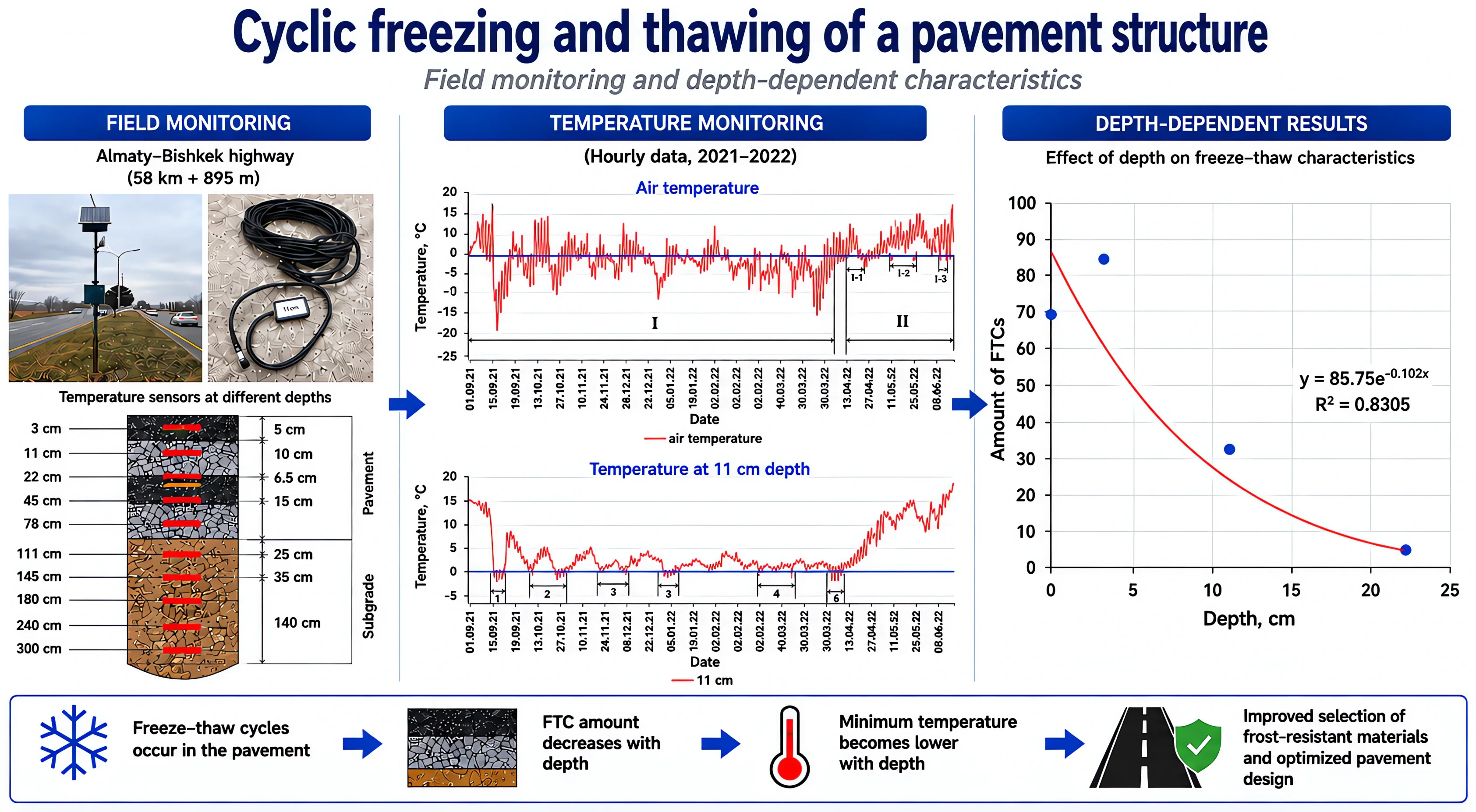
This paper examines the cyclic freezing and thawing of a pavement structure on a section of the Almaty-Bishkek highway in southeastern Kazakhstan. Temperature measurements were made using a continuous monitoring system with sensors. The characteristics (amount, duration and minimum temperatures) of the freeze-thaw cycles on the asphalt concrete pavement surface and at different depths were determined. Their dependences on depth were constructed and analyzed.
Highlights
- Long-term sensor monitoring quantified freeze–thaw cycle characteristics at multiple depths in a highway pavement structure.
- Freeze–thaw cycle amount and absolute value of lowest minimum temperature decreased exponentially with increasing pavement depth.
- The developed depth relationships can support selection of frost-resistant pavement materials and improve pavement design in cold climates.
- Deep pavement layers experienced fewer but much longer freeze–thaw cycles than the pavement surface.
1. Introduction
In road science and practice the main types of road pavement failure are considered to be rutting, fatigue and low-temperature cracks [1, 2]. The current US regulatory document contains methods for taking these mechanical failures into account at the design stage of road pavement structures [3]. In accordance with the requirements of standards [4, 5] in Kazakhstan flexible road pavement structures are designed taking into account the fatigue failure of monolithic (asphalt concrete) layers. Since the deformation and strength properties of asphalt concretes, soils and other road materials depend on loading parameters [6-8], temperature [9, 10] and moisture [11], it is necessary to have as detailed information as possible about the modes of movement of transport facility [12, 13], changes in temperature and moisture.
Field experimental studies have shown that freeze-thaw cycle (FTC) processes in road pavement layers should be given special attention in the southeastern region of Kazakhstan [14-16]. In particular the study [16] showed that during the last cold period (winter of 2024-2025) the amount of FTCs of the asphalt concrete pavement surface in Almaty was 76. FTCs significantly accelerate the degradation of wet road materials (especially asphalt concrete pavement surface) due to the “wedge effect”, which gradually reduces the adhesion between bitumen and aggregate materials and accelerates the peeling of aggregate materials.
This paper examines the characteristics of FTCs on a section of the Almaty-Bishkek highway located in the southeastern region of Kazakhstan.
2. Experimental
2.1. Experimental section
For the purpose of a long-term monitoring of temperature and moisture in layers of a highway pavement and its subgrade, an experimental section was selected not far from Almaty (at 58 km + 895 m) on the “Almaty-Bishkek” highway, where a set of sensors for temperature and moisture were installed.
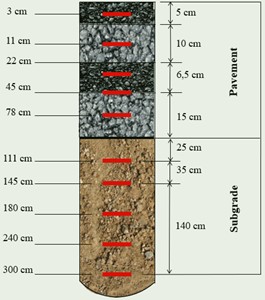
The pavement structure includes six layers. The properties of the pavement layers and subgrade soil are presented in Table 1.
Table 1Pavement layers and subgrade soil properties in the test section [17]
No. | Materials of pavement layers and subgrade soil | Thickness , cm |
1 | Fine-grained dense asphalt concrete | 5 |
2 | Coarse-grained porous asphalt concrete | 10 |
3 | Fine-grained dense asphalt concrete | 6.5 |
4 | Coarse-grained porous asphalt concrete | 15 |
5 | Fine sand and gravel mix | 25 |
6 | Coarse sand and gravel mix | 35 |
Subgrade soil | Heavy sandy clay loam | 140 |
2.2. Temperature and moisture monitoring system
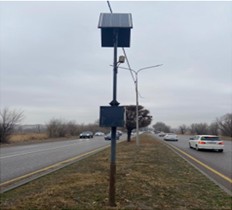
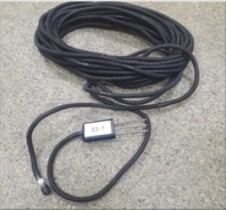
A highway monitoring system for long-term temperature and moisture measurements was installed (Fig. 1), consisting of above-ground and underground parts. The above-ground unit includes solar panels, power storage and a data control/transfer module. The underground part contains temperature (thermal resistance) and moisture (dielectric permittivity) sensors placed at different depths in the pavement and subgrade layers (3-300 cm) (Fig. 2). Data are recorded hourly and stored automatically [18].
Fig. 1Temperature and moisture monitoring system: a) above-ground module; b) sensors. The photographs presented in this paper were taken by the author Aizhan Muta during field studies carried out on December 8, 2025 on the experimental section located near Almaty (58 km + 895 m on the Almaty–Bishkek highway)
a)
b)
Fig. 2Sensor layout in the pavement structure and subgrade on the experimental section of the Almaty-Bishkek highway
3. Results and discussion
3.1. Freeze-thaw cycles
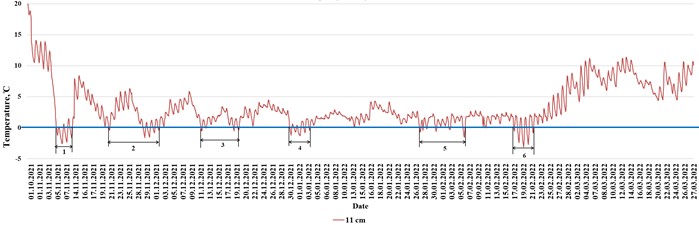
As illustrative examples Figs. 3 and 4 show graphs of changes in air temperature and at a depth of 11 cm (in the middle of the second asphalt concrete layer of the pavement) during the cold period (autumn, winter and spring seasons) of 2021 and 2022.
Fig. 3Graph of air temperature changes indicating freeze-thaw cycles
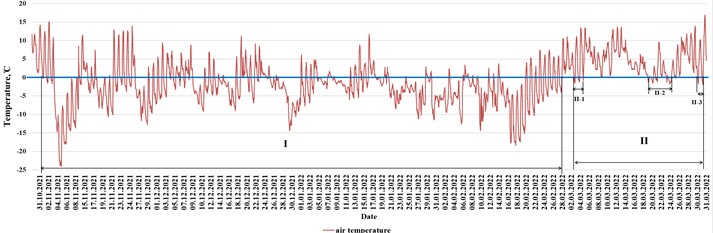
Fig. 4Graph of air temperature changes indicating freeze-thaw cycles at a depth of 11 cm
3.2. Characteristics of FTCs
It can be seen that the characteristics of FTCs (start, end, duration and minimum temperature) are stochastic. These characteristics also depend on depth. The analysis revealed that the durations of individual FTCs on the asphalt concrete pavement surface (according to the air temperature graph) and at certain depths (3 cm and 22 cm) vary widely. For example, the maximum duration of freeze-thaw cycles on the asphalt concrete pavement surface and at a depth of 22 cm reaches 218.2 and 731 hours, respectively. And at a depth of 11 cm this value is 22.2 hours.
The highest minimum temperature at all the depths considered and on the asphalt concrete pavement surface is practically the same and ranges from –0.1°C to –0.3°C; the absolute values of the lowest and average minimum temperatures increase with depth (Table 2).
Table 2Characteristics of FTCs at different depths
Depth, cm | Amount of FTCs | Duration of FTCs, hour | Minimum temperature of FTCs, °C | ||||
Minimum | Maximum | Average | Lowest | Highest | Average | ||
0 | 70 | 2.0 | 218.2 | 110.1 | –2.4 | –0.1 | –1.3 |
3 | 83 | 4.0 | 104.4 | 54.2 | –2.9 | –0.2 | –1.6 |
11 | 26 | 5.0 | 22.2 | 13.6 | –12.5 | –0.1 | –6.3 |
22 | 9 | 4.0 | 731.0 | 367.5 | –24.1 | –0.3 | –12.2 |
The results show that the amount of freeze-thaw cycles decreases with increasing depth and this dependence can be approximated by an exponential function (0.83) (Fig. 5); the dependences of the absolute values of the lowest and average minimum temperatures on depth are also described with high accuracy ( 0.92 and 0.94, respectively) by an exponential function (Fig. 6): the absolute value of the lowest minimum temperature decreases with depth and the absolute value of the average minimum temperature increases with depth [16].
Reducing the amount and the absolute value of the minimum temperature of FTCs with depth has a positive effect as it makes it possible to use relatively cheap frost-resistant materials in the lower layers of the pavement. When designing a pavement according to the mathematical model in Fig. 5 it is possible to determine the annual amount of FTCs for which it is necessary to choose a frost-resistant material.
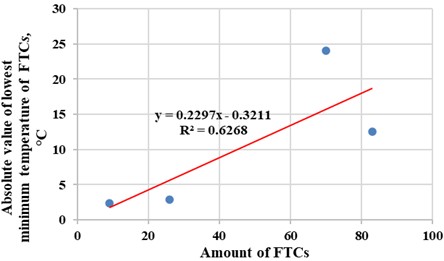
There is a correlation between the amount and the absolute value of the lowest minimum temperature of FTCs (Fig. 7).
Fig. 5Change in the amount of FTCs by depth
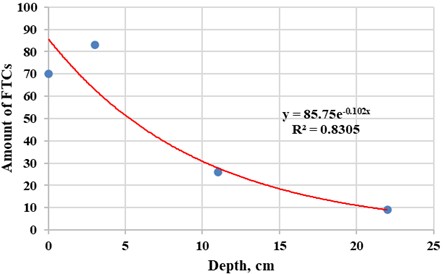
Fig. 6Dependence of the absolute value of the lowest minimum temperature of FTCs on depth
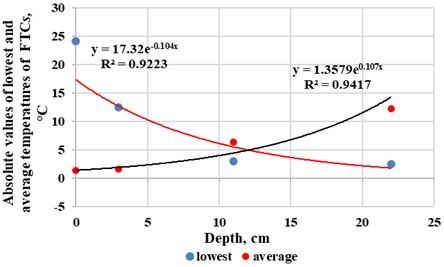
Fig. 7Relationship between the amount of FTCs and the absolute value of the lowest minimum temperature
4. Conclusions
1) In order to accumulate data it is necessary to continue measuring temperature.
2) Since the characteristics of FTCs have a stochastic (random) nature after accumulating the required sample sizes it is recommended to apply the methods of the probability theory and the mathematical statistics for processing and further analysis.
References
-
E. J. Yoder and M. W. Witczak, Principles of Pavement Design. New Jersey: Wiley, 2008, p. 736, https://doi.org/10.1002/9780470172919
-
A. T. Papagiannakis and E. A. Masad, Pavement Design and Materials. New Jersey: Wiley, 2012, p. 560, https://doi.org/10.1002/9780470259924
-
“Guide for mechanistic-empirical design of new and rehabilitated pavement structures,” National Cooperative Highway Research Program, Transportation Research Board, National Research Council, 2004.
-
“Design of flexible pavements,” Astana, SP RK 3.03-104-2014*, 2019.
-
“Design of flexible pavements,” SN RK 3.03-04-2014, Astana, 2015.
-
A. I. Iskakbayev, B. B. Teltayev, and C. O. Rossi, “Deformation and strength of asphalt concrete under static and step loadings,” in Transport Infrastructure and Systems, London, UK: CRC Press, 2017, pp. 3–8, https://doi.org/10.1201/9781315281896-1
-
A. Iskakbayev, B. Teltayev, and S. Alexandrov, “Determination of the creep parameters of linear viscoelastic materials,” Journal of Applied Mathematics, Vol. 2016, pp. 1–6, Jan. 2016, https://doi.org/10.1155/2016/6568347
-
B. B. Teltayev, E. D. Amirbayev, and B. S. Radovskiy, “Viscoelastic characteristics of blown bitumen at low temperatures,” Construction and Building Materials, Vol. 189, pp. 54–61, Nov. 2018, https://doi.org/10.1016/j.conbuildmat.2018.08.200
-
B. B. Teltayev and E. A. Suppes, “Temperature and moisture in a highway in the south of Kazakhstan,” Transportation Geotechnics, Vol. 21, p. 100292, Dec. 2019, https://doi.org/10.1016/j.trgeo.2019.100292
-
B. Teltayev, J. Liu, and E. Suppes, “Distribution of temperature, moisture, stress and strain in the highway,” (in Russian), Magazine of Civil Engineering, Vol. 83, No. 7, pp. 102–113, 2018, https://doi.org/10.18720/mce.83.10
-
B. B. Teltayev, A. I. Baibatyrov, and E. A. Suppes, “Characteristics of highway subgrade frost penetration in regions of the Kazakhstan,” Japanese Geotechnical Society Special Publication, Vol. 2, No. 47, pp. 1664–1668, 2016, https://doi.org/10.3208/jgssp.kaz-08
-
B. Teltayev, Y. Aitbayev, and A. Zhaisanbayev, “Problems of rutting on asphalt pavements,” Vibroengineering Procedia, Vol. 55, pp. 175–180, Sep. 2024, https://doi.org/10.21595/vp.2024.24088
-
B. Teltayev, Y. Aitbayev, and A. Zhaisanbayev, “To the study of plastic deformation of road asphalt concrete pavement,” in AIP Conference Proceedings, Vol. 3177, p. 050008, Jan. 2025, https://doi.org/10.1063/5.0295262
-
B. B. Teltayev, G. Loprencipe, Y. Y. Aitbayev, A. S. Zhaisanbayev, G. I. Salgarayeva, and A. N. Muta, “Characteristics of cyclic freeze-thaw of a highway pavement and subgrade,” Engineered Science, Vol. 40, p. 2083, Jan. 2026, https://doi.org/10.30919/es2083
-
B. Teltayev, A. Muta, Y. Aitbayev, and A. Zhaisanbayev, “Cyclic freeze-thaw characteristics of asphalt concrete pavement in Almaty region,” in AIP Conference Proceedings, Vol. 3405, p. 110001, Jan. 2026, https://doi.org/10.1063/12.0043294
-
B. Teltayev, Y. Aitbayev, A. Zhaisanbayev, and A. Muta, “Characteristics of cyclic freeze-thaw of a city road,” Results in Engineering, Vol. 30, p. 110536, Jun. 2026, https://doi.org/10.1016/j.rineng.2026.110536
-
B. Teltayev, G. Loprencipe, G. Bonin, E. A. Suppes, and K. Tileu, “Temperature and moisture in highways in different climatic regions,” Magazine of Civil Engineering, Vol. 100, No. 8, p. 10011, 2020, https://doi.org/10.18720/mce.100.11
-
B. B. Teltayev and A. N. Muta, “Distribution of temperature in pavement and soil base in the South-Eastern Kazakhstan,” Case Studies in Thermal Engineering, Vol. 82, p. 108100, Jun. 2026, https://doi.org/10.1016/j.csite.2026.108100
About this article

This research was supported by the Fundamental Research Grant from the Ministry of Science and Higher Education of the Republic of Kazakhstan (Grant Number: BR31715767, U. Joldasbekov IME).
The datasets generated during and/or analyzed during the current study are available from the corresponding author on reasonable request.
The authors declare that they have no conflict of interest.

