Abstract
This research addresses critical environmental issues by introducing an efficient method for recycling and reusing construction and demolition waste generated from old buildings. A comprehensive study was conducted on rubble concrete to evaluate whether coarse aggregates derived from recycled concrete waste comply with international standard requirements. The experimental results justify the application of these recycled products in both monolithic concreting and the manufacturing of precast concrete. By proposing a sustainable waste utilization model, this study demonstrates a significant reduction in the environmental footprint of the construction industry.
Highlights
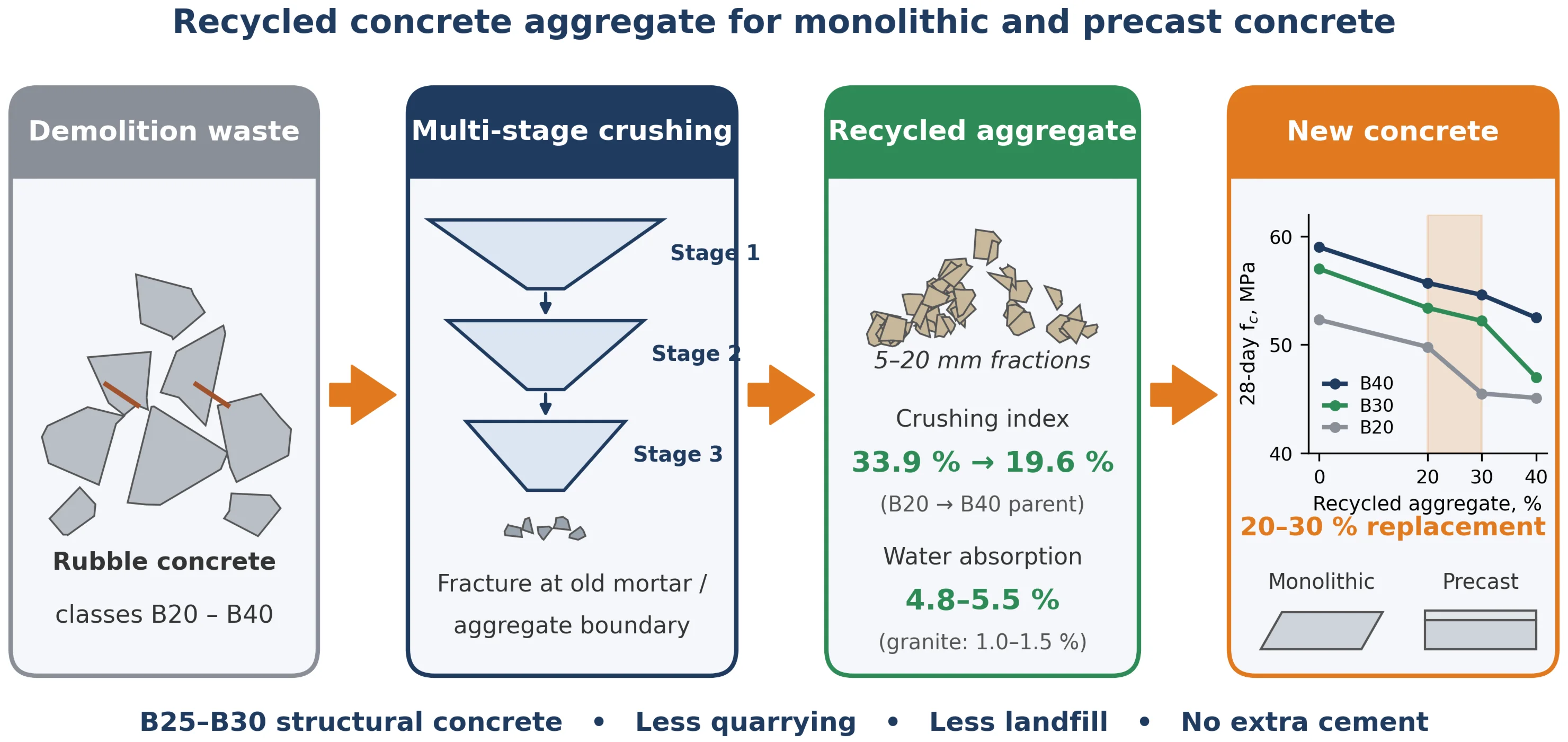
- Multi-stage crushing separates old mortar from recycled concrete aggregate
- Crushing index drops from 33.9 % to 19.6 % as parent concrete rises from B20 to B40
- Recycled aggregate absorbs 4.8–5.5 % water versus 1.0–1.5 % for granite.
- Replacing 20–30 % of natural aggregate still yields B25-class structural concrete
- Recycled aggregate suits monolithic and precast concrete, reducing quarrying and landfill.
1. Introduction
Rapid urbanization has made concrete the most widely used construction material globally, yet it poses severe environmental threats due to extensive raw material extraction, high greenhouse gas emissions, and the generation of vast quantities of demolition waste. To preserve natural resources and achieve global carbon-neutral goals, efficient disposal and recycling strategies are strictly required.
Studies indicate that during the mechanical crushing of concrete debris, the particle distribution typically yields 60 % with a diameter of 20 mm, 20 % at 10 mm, and 20 % at 5 mm. [1, 2]. Traditional single-stage crushing often leaves a significant amount of old cement mortar adhered to the aggregate surface, which decreases the density (by up to 2.6 %) and increases water absorption to 4.8-5.5 % (compared to 1.0-1.5 % for natural granite) [9-11].
As a solution to this issue, the study emphasizes the application of multi-stage crushing technology. Because fragmentation during multi-stage crushing occurs precisely at the boundary between the old cement stone and original filler particles, it ensures flawless removal of the adhered residue. The resulting high-quality coarse aggregates can be successfully implemented not only in low-grade but also in high-grade structural concrete [3, 4, 20].
2. Materials and research methods
The experimental program utilized aggregates obtained from recycled demolition concrete of primary compressive strength classes B20, B25, B30, and B40. The granular composition analysis was conducted in accordance with GOST 8269.0-97 (“Crushed stone and gravel from dense rocks and industrial waste for construction work. Physical and mechanical test methods”). Technical compliance and requirements for the recycled crushed stone were evaluated based on GOST 8267-93 (“Crushed stone and gravel from dense rocks for construction work. Technical conditions”).
To evaluate physical-mechanical performance, standard 10×10×10 cm cubic specimens and 15×15×60 cm beams were cast. A 1.0 % dosage of Rheobuild 561 superplasticizer was introduced to manage workability.
3. Discussions
The results of determining the strength (crushing index grade) of recycled aggregate (RA) obtained from different classes of primary concrete are shown in Table 1.
Table 1Strength of recycled crushed stone obtained from primary concrete of class B20 (mark of crushing index – Cİ)
No | Fraction sizes/sieve hole diameter, mm | Mass, g | CI, % | CI average, % | CI of the mixed fraction, % | Mark of CI | |
Sample | Residue on sieve | ||||||
1 | (5- 10)/1.25 | 271 | 179 | 33.95 | 34.06 | 33.88 | 300 |
278 | 183 | 34.17 | |||||
2 | (10- 20)/2.5 | 280 | 184 | 34.29 | 33.70 | ||
302 | 202 | 33.11 | |||||
Strength of recycled crushed stone obtained from primary concrete of class B25 (mark of crushing index – CI) | |||||||
1 | (5- 10)/1.25 | 286 | 217 | 24.13 | 23.14 | 23.18 | 300 |
280 | 218 | 22.14 | |||||
2 | (10- 20)/2.5 | 281 | 217 | 22.78 | 23.22 | ||
279 | 213 | 23.66 | |||||
Strength of recycled crushed stone obtained from primary concrete of class B30 (mark of crushing index – CI) | |||||||
1 | (5- 10)/1.25 | 306 | 247 | 19.3 | 23.14 | 23.18 | 300 |
309 | 252 | 18.4 | |||||
2 | (10- 20)/2.5 | 285 | 222 | 22.11 | 23.22 | ||
283 | 231 | 18.37 | |||||
Strength of recycled crushed stone obtained from primary concrete of class B40 (mark of crushing index – CI) | |||||||
1 | (5-10)/1.25 13.75 | 282 | 243 | 13.83 | 18.85 | 19.55 | 600 |
288 | 246 | 14.60 | |||||
2 | 800 | 280 | 243 | 13.21 | 20.24 | ||
284 | 246 | 13.38 | |||||
The analysis of the results obtained to determine the strength of recycled crushed stone showed that the strength of recycled crushed stone increases with the strength of the original concrete. When the concrete class increases from B20 to B40, the grade of recycled crushed stone increases from 300 to 800.
Table 2 shows that the introduction of recycled aggregate into the aggregate mix increases the water demand and water/cement ratio of the concrete mix. The results show that when the amount of recycled aggregate in the aggregate mix is 40 %, the water demand of the control concretes made from natural granite aggregate increases from 152...154 l/m3 to 167...171 l/m3 and the water/cement ratio increases from 0.367 to 0.403...0.411, to ensure the flowability of the concrete mix at 6.5-8 cm, while the water/cement ratio increases from 0.367 to 0.403...0.411.
At the same time, the increase in water demand and water/cement ratio is the same for all three types of recycled aggregate studied and varies depending on their amount: at 20 %-6.5 %, at 30 %-8.5 %, at 40 %-12.5 %. This increase is justified by the higher water absorption of recycled crushed stone compared to granite crushed stone. According to our results, the water absorption of recycled crushed stone is 4.8-5.5 %, while the water absorption of granite crushed stone is 1.0-1.5 %. This is explained by the fact that a certain part of the cement mortar remains on the surface of recycled crushed stone and is characterized by a decrease in the average density of the concrete mixture to 2.6 %.
Analysis of the test results given in Fig. 1-3 on the compressive strength of 10x10x10 sm cubic samples prepared from the studied compositions proves that when natural granite crushed stone is replaced by recycled crushed stone obtained from crushing various brands of rubble concrete, a decrease in strength is observed both after heat-moisture treatment (HMT) and after 7 and 28 days after HMT.
Table 2Composition and properties of concrete mix with the application of RA obtained from concrete grinding
Composition | 1 m3 concrete material consumption, kg | Slump, cm | Average density, kg/m3 | |||||
Cement | Aggregate | Sand, kg | SP | Water | ||||
Natural | RA | |||||||
Based on recycled aggregate from B20 concrete (1 sample) | ||||||||
1 2 3 4 | 414 420 417 416 | 1223 982 836 727 | 0 224 331 442 | 648 656 652 650 | 2.48 2.52 2.50 2.50 | 152 163 166 171 | 7 7 8 7.5 | 2437 2446 2403 2406 |
Based on recycled aggregate from B30 concrete (1 sample) | ||||||||
1 2 3 4 | 419 423 427 415 | 1237 990 856 726 | 0 227 339 443 | 655 661 668 650 | 2.51 2.54 2.56 2.49 | 154 164 169 169 | 6.5 6.5 6.5 6.5 | 2465 2464 2459 2402 |
Based on recycled aggregate from B40 concrete (1 sample) | ||||||||
1 2 3 4 | 416 420 418 415 | 1228 982 837 726 | 0 226 333 446 | 651 656 653 650 | 2.50 2.52 2.51 2.49 | 153 162 164 167 | 7.5 6.5 7 8 | 2448 2446 2406 2403 |
Fig. 1Strength of concrete prepared from B20 concrete based on recycled aggregate
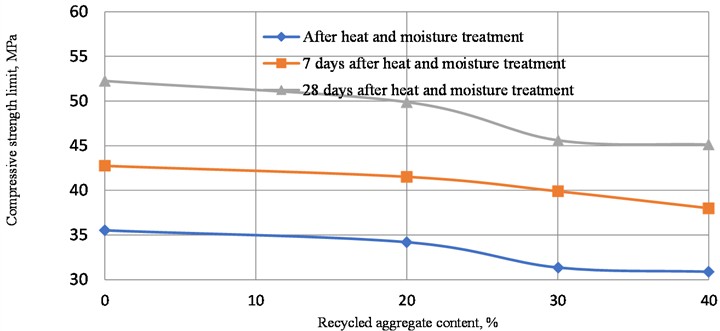
A comparative analysis of the compressive strength limits of the concretes studied after 28 days of HMT shows that, depending on the amount of recycled crushed stone, concretes of class B30-40 (in terms of compressive strength) can be obtained based on mixed crushed stone.
Researchers have proposed grinding waste cement with mineral additives to improve its fineness [12]. After thermal activation, dehydrated RS particles have a porous structure and a lower surface area, which is significantly rougher than PS particles [13]. In contrast, conventional PS particles are non-porous and have a smooth surface [14]. The density of RS particles is usually slightly lower than PS and is approximately 2400-3200 kg/m3, depending on the processing temperature.
All fractions of crushed stone meet the requirements of the standard in terms of granular composition. The average density of recycled crushed stone is 1173 kg/m3, the voids are 53 %, the amount of needle and plate-shaped grains is 22.8 %, and the amount of dust and clay particles is 0.04 %.
Fig. 2Strength of concrete prepared from B30 concrete based on recycled aggregate
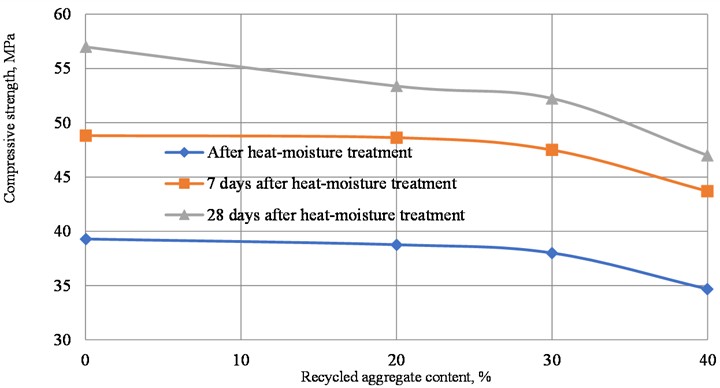
Fig. 3Strength of concrete prepared from B40 concrete based on recycled aggregate
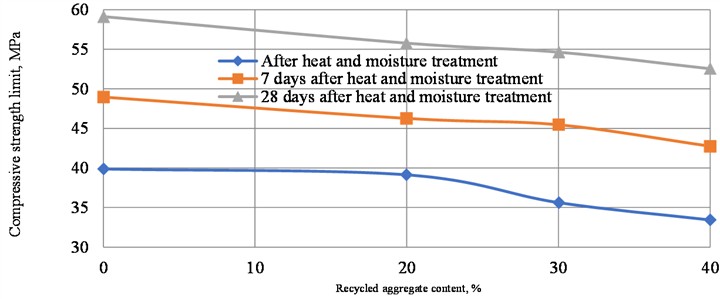
Table 3Concrete mixtures with the use of recycled crushed stone
Components | Composition of concrete mix, kg/m3 | ||||||
1 | 2 | 3 | 4 | 5 | 6 | 7 | |
Cement | 307 | 307 | 307 | 307 | 307 | 307 | 307 |
Water | 175 | 175 | 175 | 175 | 175 | 175 | 175 |
Sand | 788.6 | 788.6 | 788.6 | 788.6 | 788.6 | 788.6 | 788.6 |
Agregates | 1158,6 | 984,3 | 927 | 868,6 | 811 | 753 | 695 |
Recycled agregates, (%) | – | 174.3 (15%) | 231.6 (20%) | 290 (25%) | 347.6 (30%) | 405.6 (35%) | 463.6 (40%) |
To determine the physical and mechanical properties of these compositions, cubes measuring 10x10x10 cm and beams measuring 15×15×60 cm were molded. The bending and compressive strength limits were determined using a hydraulic press (Table 4).
The flowability of the concrete mixture, determined using the Abrams cone, varies depending on the amount of recycled aggregate. The largest value of the cone collapse was obtained when the amount of recycled aggregate was 15 %.
All compositions give results corresponding to the activity of B25 class concrete, but compared to the control samples, when using recycled crushed stone, a decrease of 12.4-22.5 % in the compressive strength of concrete is observed after 28 days. As the amount of recycled crushed stone decreases, the flexural strength of concrete increases. When adding recycled crushed stone by 14.7 %, the flexural strength increases by 20 % compared to the control samples.
The results of the studies show that B25 class concrete can be produced from recycled crushed stone. It is recommended to use multi-stage crushing of rubble concrete to obtain a filler with high strength properties. Compositions No. 3 and 4 during the study had properties close to the control composition and are considered optimal compositions. As the most widely used construction material in the world, concrete is becoming a serious problem for the environment due to the significant extraction of raw materials and the emission of greenhouse gases and the generation of a large amount of construction and demolition waste.
Table 4Physical and mechanical properties of concrete
Concrete composition | Flowability of concrete mix, cm | Compressive strength, MPa | Flexural strength, MPa |
1 | 13.5 | 43.2 | 4.82 |
2 | 15.5 | 37.86 | 5.53 |
3 | 14.5 | 37.6 | 5.12 |
4 | 14 | 36.16 | 5.21 |
5 | 12.5 | 34.27 | 4.38 |
6 | 12 | 37.06 | 4.66 |
7 | 11 | 33.47 | 4.22 |
4. Conclusions
1) The mechanical grade of recycled concrete aggregate is explicitly dependent on the strength of the parent material. Aggregates derived from B40 rubble concrete achieve a high-quality grade of 800.
2) High-performance structural concrete of classes B20 to B30 can be successfully formulated by replacing 20 % to 30 % of natural aggregates with multi-stage recycled concrete scrap.
3) Multi-stage crushing is strongly recommended as the optimal technological approach to eliminate weak cement-stone boundaries and deliver stable, eco-efficient coarse fillers for the modern construction industry.
Environmental perspective: This dependency plays a critical role in resource conservation. By upcycling high-strength B40 rubble into a premium grade 800 aggregate, the construction industry can directly substitute primary natural resources like granite and basalt. This significantly reduces the environmental destruction caused by open-pit mining and quarrying, while simultaneously diverting massive volumes of heavy structural waste away from depleting landfill spaces.
Keeping the replacement within this optimal 20 % to 30 % range serves as a vital ecological safeguard. Because the mechanical properties remain stable at this ratio, there is no need to add extra Portland cement to compensate for strength loss. Given that cement production is responsible for roughly 8 % of global CO2 emissions, maintaining a low cement-to-aggregate ratio ensures a genuine reduction in the carbon footprint of B20 to B30 concrete mixtures.
From an environmental standpoint, multi-stage crushing is the ultimate enabler of a true circular economy. While single-stage crushing leaves porous mortar that demands excessive water and chemical admixtures, this advanced mechanical processing cleans the aggregate efficiently. Furthermore, the fine concrete dust separated during this multi-stage processing can be captured and utilized for carbon sequestration (CO2 mineral carbonation), transforming a waste-management challenge into an active climate-mitigation strategy.
References
-
A. A. Guvalov, “Study of crushed stone obtained from crushing of different brands of rubble concrete,” Scientific Works of the Azerbaijan University of Architecture and Construction, No. 2, pp. 69–78, 2022.
-
Z. A. Estemesov, B. K. Sarsenbaev, G. O. Karshyga, A. F. Seisenov, and A. A. Adilbaev, “Technology for obtaining coarse and fine aggregate from concrete scrap,” (in Russian), Bulletin of GGNTU. Technical Sciences, Vol. 17, No. 1(23), pp. 83–93, 2021, https://doi.org/10.34708/gstou.2021.47.82.009
-
M. O. Korovkin, N. A. Eroshkina, and A. A. Khristosov, “Improving the efficiency of recycling concrete scrap in concrete technology,” Education and Science in the Modern World. Innovations, No. 2, pp. 158–166, 2020.
-
A. A. Guvalov and S. I. Abbasova, “The effect of crushed stone obtained from crushing different brands of rubble concrete on the properties of concrete mix and concrete,” Construction and Architecture in Azerbaijan, Vol. 1, No. 34, pp. 2–9, 2023.
-
L. A. Weisberg and E. E. Kameneva, “Study of the composition and physical and mechanical properties of secondary crushed stone from crushed concrete,” Construction Materials, No. 6, pp. 41–45, 2014.
-
S. M. Pulyaev, M. B. Kaddo, and I. S. Pulyaev, “Study of the process of early structure formation of concrete on crushed stone from concrete scrap,” Bulletin of MGSU, No. 1, pp. 68–71, 2012.
-
A. Ahmed, R. Lesovik, S. Al Mamouri, and T. Gunchenko, “Composite binders based on concrete scrap,” Bulletin of Belgorod State Technological University Named After. V. G. Shukhov, No. 7, pp. 8–18, 2020, https://doi.org/10.34031/2071-7318-2020-5-7-8-18
-
M. A. Fakhratov and D. A. Fayzullin, “Organizational problems of industrial waste use,” (in Russian), Engineering bulletin of the Don, No. 3, 2018.
-
C. Hoffmann Sampaio et al., “Demolished concretes recycling by the use of pneumatic jigs,” Waste Management and Research: The Journal for a Sustainable Circular Economy, Vol. 38, No. 4, pp. 392–399, 2020, https://doi.org/10.1177/0734242x20902835
-
A. A. Guvalov, “Reducing the environmental impact of the construction industry and environmental measures,” Journal of the Azerbaijan Oil Industry, pp. 43–48, 2023.
-
W. Chen et al., “Adopting recycled aggregates as sustainable construction materials: A review of the scientific literature,” Construction and Building Materials, Vol. 218, pp. 483–496, May 2019, https://doi.org/10.1016/j.conbuildmat.2019.05.130
-
R. Serpell and M. Lopez, “Reactivated cementitious materials from hydrated cement paste wastes,” Cement and Concrete Composites, Vol. 39, pp. 104–114, Apr. 2013, https://doi.org/10.1016/j.cemconcomp.2013.03.020
-
Z. He, X. Zhu, J. Wang, M. Mu, and Y. Wang, “Comparison of CO2 emissions from OPC and recycled cement production,” Construction and Building Materials, Vol. 211, pp. 965–973, Mar. 2019, https://doi.org/10.1016/j.conbuildmat.2019.03.289
-
F. Splittgerber and A. Mueller, “Inversion of the cement hydration as a new method for identification and/or recycling,” 11th International Congress on the Chemistry of Cement, pp. 1282–1291, 2003, https://doi.org/10.13140/2.1.2201.3766
-
T. Amirov, A. Urakov, X. Aripov, B. Qurbonov, and M. Tuxtayev, “Forecasting model of strength indicators of gravel-sand mixture treated with cement,” in AIP Conference Proceedings, Vol. 2612, p. 040028, Mar. 2023, https://doi.org/10.1063/5.0115578
-
T. Amirov, K. Muminov, M. Dauletov, and S. Raxmatov, “Evaluating the impact of elevations between concrete pavement slabs on road surface smoothness,” (in Russian), International Scientific Journal "Engineer", Vol. 3, No. 1, pp. 64–69, 2025, https://doi.org/10.56143/3030-3893-2025-1-64-69
-
K. Urolova and A. Urokov, “Maintenance of cement concrete pavements: Defects and their elimination,” Academia Open, Vol. 10, No. 1, Feb. 2025, https://doi.org/10.21070/acopen.10.2025.10512
-
T. Amirov, K. Aripov, M. Tukhtayev, and S. Rakhmatov, “Study of the influence of the share of sand in the mixture aggregates for the physical and mechanical properties of road heavy concrete mixtures,” in AIP Conference Proceedings, Vol. 3244, p. 040005, 2024, https://doi.org/10.1063/5.0242117
-
T. Amirov, “Determination of the time of cutting seams on freshly laid monolithic cement concrete pavements,” Railway Transport: Topical Issues and Innovations, No. 1, 2022.
About this article

The authors have not disclosed any funding.
Mr. Abbas Guvalov acknowledges the Director of the Technology Transfer Center at the Azerbaijan University of Architecture and Construction (AzMIU) for supporting the academic collaboration during the “Holcim Concrete! Innovative Solutions in Construction” assembly.
Ms. Saida Abbasova acknowledges the research support provided by the Azerbaijan University of Architecture and Construction (AzMIU).
The datasets generated during and/or analyzed during the current study are available from the corresponding author on reasonable request.
The authors declare that they have no conflict of interest.

